The Asia Pacific Desktop Virtualization Market would witness market growth of 11.2% CAGR during the forecast period (2025-2032).
The China market dominated the Asia Pacific Desktop Virtualization Market by Country in 2024, and would continue to be a dominant market till 2032; thereby, achieving a market value of $2,177.2 million by 2032. The Japan market is registering a CAGR of 10.5% during (2025 - 2032). Additionally, The India market would showcase a CAGR of 11.9% during (2025 - 2032). The China and Japan led the Asia Pacific Desktop Virtualization Market by Country with a market share of 31.9% and 18.2% in 2024. The Singapore market is expected to witness a CAGR of 13.3% during throughout the forecast period.
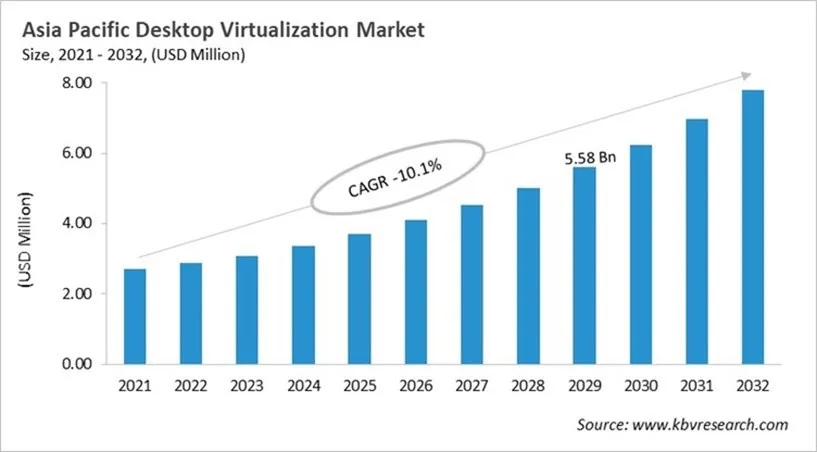
The Asia Pacific desktop virtualization market has grown quickly thanks to widespread digital transformation, cloud adoption, and government-backed programs that promote safe remote computing. The early adopters focused on modernizing IT infrastructure, making it easier for workers to move around, and cutting down on the amount of time spent managing physical desktops. The public sector, BFSI, education, and IT services were all very supportive. The COVID-19 pandemic sped up deployment even more because businesses wanted to keep running and make it easier for employees to work from home. As more money is spent on regional data centers, data localization rules, and cybersecurity rules, virtual desktop environments will continue to be important in both developed and developing APAC economies.
Right now, the market is shaped by a strong demand for hybrid and cloud-based desktop virtualization, better security frameworks, and flexible work models. Businesses are using hybrid cloud deployments more and more to find a balance between following the rules and being able to grow. They also use zero-trust, identity-based access, and centralized data protection. Global vendors stay on top by expanding their cloud services to more regions, improving performance, and making hybrid cloud possible. Local cloud providers and system integrators help them do this. Overall, strong competition, changing compliance needs, and the continued use of hybrid work are all factors that keep APAC's desktop virtualization ecosystem growing and coming up with new ideas.
Based on Deployment Mode, the market is segmented into Cloud, and On-premise. The Cloud market segment dominated the Japan Desktop Virtualization Market by Deployment Mode is expected to grow at a CAGR of 10.7 % during the forecast period thereby continuing its dominance until 2032. Also, The On-premise market is anticipated to grow as a CAGR of 10.2 % during the forecast period during (2025 - 2032).
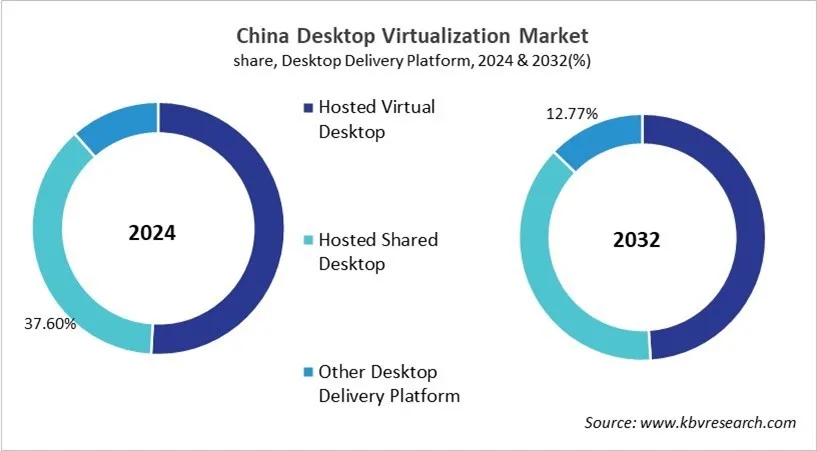
Based on Desktop Delivery Platform, the market is segmented into Hosted Virtual Desktop, Hosted Shared Desktop, and Other Desktop Delivery Platform. Among various China Desktop Virtualization Market by Desktop Delivery Platform; The Hosted Virtual Desktop market achieved a market size of USD $544.8 Million in 2024 and is expected to grow at a CAGR of 8.9 % during the forecast period. The Hosted Shared Desktop market is predicted to experience a CAGR of 9.7% throughout the forecast period from (2025 - 2032).
Free Valuable Insights: The Desktop Virtualization Market is Predicted to reach USD 29.02 Billion by 2032, at a CAGR of 10.4%
China has one of the biggest and fastest-growing desktop virtualization markets in the Asia Pacific. This is because the government is pushing for digital transformation, businesses are modernizing, and key industries are widely adopting cloud computing. Companies use virtual desktops to make data safer, manage IT from one place, support remote and hybrid work, and make sure that all of China's many employees can access the same applications. Adoption is sped up when domestic cloud providers offer infrastructure that can grow and is in line with data sovereignty and cybersecurity needs. Trends like cloud-hosted and GPU-accelerated virtual desktops, AI-enabled management, and more use in education and public administration are helping the market grow. Even though there are still problems with integrating legacy systems and uneven digital maturity, competition is increasingly favoring providers that offer high performance, low costs, compliance, and smooth integration with cloud-native and AI-driven environments.

By Deployment Mode
By Desktop Delivery Platform
By End-User Vertical
By Country
Our team of dedicated experts can provide you with attractive expansion opportunities for your business.






 Unique Offerings