The Europe Blockchain Distributed Ledger Market is expected to reach $6.20 billion by 2031 and would witness market growth of 22.9% CAGR during the forecast period (2025-2032).
The Germany market dominated the Europe Blockchain Distributed Ledger Market by Country in 2024, and would continue to be a dominant market till 2032; thereby, achieving a market value of $1,608 million by 2032. The UK market is experiencing a CAGR of 21.9% during (2025 - 2032). Additionally, The France market would exhibit a CAGR of 23.7% during (2025 - 2032). The Germany and UK led the Europe Blockchain Distributed Ledger Market by Country with a market share of 23% and 20.1% in 2024. The Spain market is expected to witness a CAGR of 24.4% during throughout the forecast period.
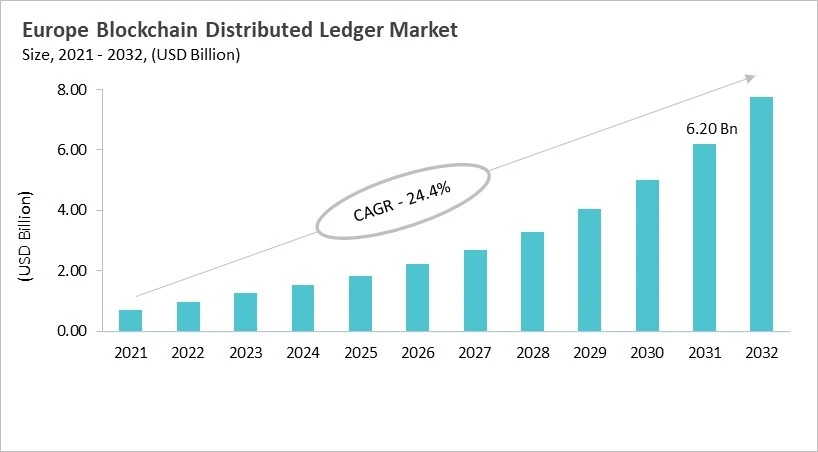
The blockchain distributed ledger market in Europe has come a long way since the early days of cryptocurrencies. Now, there is a structured digital infrastructure supported by coordinated EU policy and institutional adoption. Through projects like the European Blockchain Services Infrastructure, which allows for cross-border public services in identity, credentials, and trusted data exchange, the European Union officially added blockchain to its digital transformation agenda. The digital euro project, which showed that central banks are interested in distributed ledger frameworks, helped to make this change stronger in the financial sector. The use of enterprise software grew as supply chain, trade finance, and regulatory reporting apps were added to existing business systems.
Some important trends are the Markets in Crypto-Assets regulation, which makes rules more consistent, the rise of blockchain platforms in the public sector, and the integration of businesses for more openness and automation. Interoperability and shared standards are made possible by cooperation between governments, businesses, and open-source ecosystems. Regulatory compliance, scalability, and cross-border functionality, not just price, shape competition. Blockchain-based payments and digital securities are making it easier for financial institutions and public initiatives to have an impact on the market. Overall, Europe's market is shaped by strong policy leadership, a strong institutional framework, and the use of enterprise-grade technology.
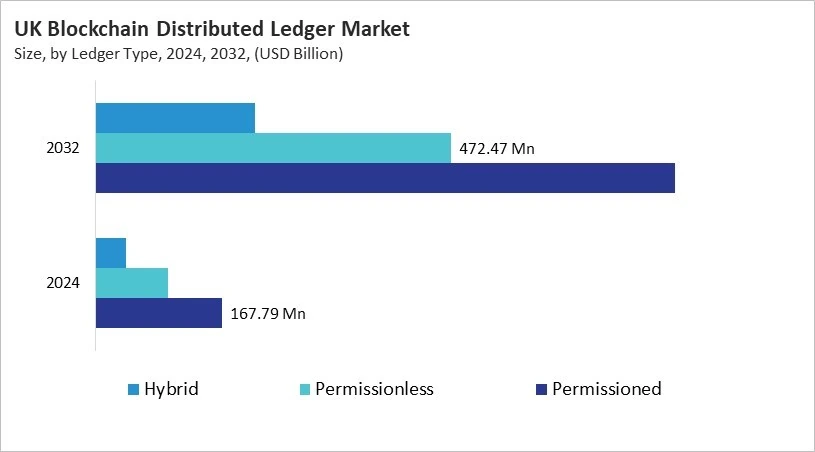
Based on Ledger Type, the market is segmented into Permissioned, Permissionless, and Hybrid. The Permissioned market segment dominated the UK Blockchain Distributed Ledger Market by Ledger Type is expected to grow at a CAGR of 21.3 % during the forecast period thereby continuing its dominance until 2032. Also, The Hybrid market is anticipated to grow as a CAGR of 23.1 % during the forecast period during (2025 - 2032).
Based on Application, the market is segmented into Cryptocurrency, Smart Contracts, Supply Chain Management, and Other Application. Among various Germany Blockchain Distributed Ledger Market by Application; The Cryptocurrency market achieved a market size of USD $139.5 Million in 2024 and is expected to grow at a CAGR of 20.6 % during the forecast period. The Supply Chain Management market is predicted to experience a CAGR of 22.1% throughout the forecast period from (2025 - 2032).
Free Valuable Insights: The Worldwide Blockchain Distributed Ledger Market is projected to reach USD 30.56 billion by 2032, at a CAGR of 23.5%
Through a national Blockchain Strategy and strong regulatory oversight by BaFin, Germany has built one of the most organized and policy-driven blockchain and distributed ledger markets in Europe. Market growth is affected by clear rules, the digitization of industries, and alignment with EU projects like the European Blockchain Services Infrastructure. More businesses in manufacturing, automotive, and finance are using supply chain traceability, smart contracts, and tokenized assets. The GDPR's rules about data protection have a big effect on how systems are designed and run. Companies that make technology, like SAP, help businesses connect their IT systems. Public-private partnerships are what make pilots in logistics, energy trading, and digital documentation possible. Instead of speculative crypto activity, competition focuses on compliance, cybersecurity, interoperability, and following EU digital finance rules.

By Deployment
By Ledger Type
By Application
By Country
Our team of dedicated experts can provide you with attractive expansion opportunities for your business.



 Unique Offerings