The Europe Desktop Virtualization Market would witness market growth of 9.9% CAGR during the forecast period (2025-2032).
The Germany market dominated the Europe Desktop Virtualization Market by Country in 2024, and would continue to be a dominant market till 2032; thereby, achieving a market value of $1,379.1 million by 2032. The UK market is exhibiting a CAGR of 8.8% during (2025 - 2032). Additionally, The France market would experience a CAGR of 10.6% during (2025 - 2032). The Germany and UK led the Europe Desktop Virtualization Market by Country with a market share of 21% and 17.9% in 2024. The Spain market is expected to witness a CAGR of 11.4% during throughout the forecast period.
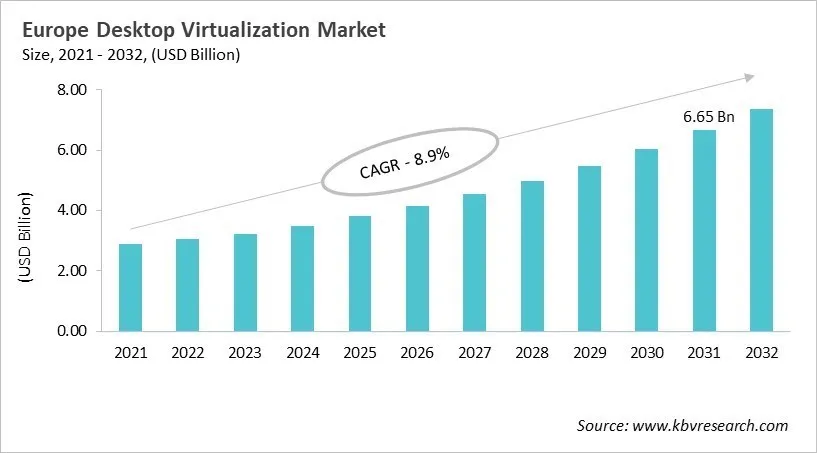
The desktop virtualization market in Europe has changed as the region's digital transformation has progressed. This is mostly due to government-led cloud and security initiatives and rules like the GDPR. Early adopters focused on centralized IT management, cost-effectiveness, and secure computing. Public sector agencies and regulated industries were the first to put these ideas into practice. Cloud computing sped up the change, and the COVID-19 pandemic made it even faster by making virtual desktops widely used to enable secure remote work. Today, hybrid and cloud-based Desktop-as-a-Service models are the most popular. They let you scale up while keeping data residency and sovereignty. Desktop virtualization is now a key part of Europe's digital workplace plans, helping with compliance, resilience, and long-term IT practices.
The European market is known for its focus on hybrid cloud, sovereign cloud solutions, and zero-trust security architectures. To meet strict rules about security and privacy, especially in healthcare, finance, and public administration, organizations use both on-premises and cloud deployments. Microsoft, Citrix, VMware, and IBM are some of the top vendors that compete by making sure their products meet European compliance standards, improving the user experience, and making hybrid work possible. Secure access, performance optimization, cloud integration, and data protection are the main areas of competition. As hybrid work and BYOD become the norm, desktop virtualization is still very important for providing flexible, safe, and compliant digital workspaces across Europe.
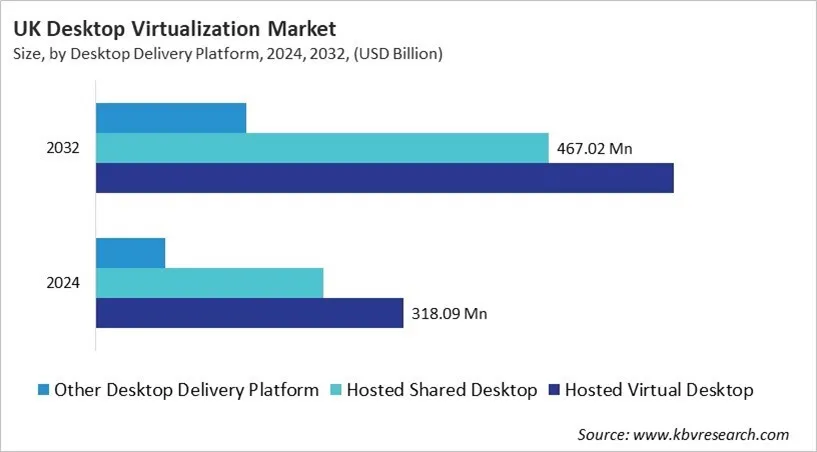
Based on Desktop Delivery Platform, the market is segmented into Hosted Virtual Desktop, Hosted Shared Desktop, and Other Desktop Delivery Platform. The Hosted Virtual Desktop market segment dominated the UK Desktop Virtualization Market by Desktop Delivery Platform is expected to grow at a CAGR of 8.3 % during the forecast period thereby continuing its dominance until 2032. Also, The Other Desktop Delivery Platform market is anticipated to grow as a CAGR of 10.1 % during the forecast period during (2025 - 2032).
Based on End-User Vertical, the market is segmented into IT & Telecommunications, Financial Services, Healthcare, Manufacturing, and Other End-User Vertical. Among various Germany Desktop Virtualization Market by End-User Vertical; The IT & Telecommunications market achieved a market size of USD $226.7 Million in 2024 and is expected to grow at a CAGR of 7.4 % during the forecast period. The Healthcare market is predicted to experience a CAGR of 9.2% throughout the forecast period from (2025 - 2032).
Free Valuable Insights: The Global Desktop Virtualization Market will Hit USD 29.02 Billion by 2032, at a CAGR of 10.4%
Germany is the most advanced desktop virtualization market in Europe because of its strong industrial base, widespread use of digital technology, and ongoing modernization of enterprise IT. Digital transformation and Industry 4.0 projects are more and more using virtual desktops to make operations more flexible, secure, and able to support remote and mobile workers in important fields like healthcare, finance, manufacturing, and public services. Adoption is mostly driven by strict requirements for cybersecurity and data protection, the need to cut costs, and the need for advanced applications to work consistently across distributed environments. Trends like cloud-hosted Desktop-as-a-Service, hybrid deployment models, AI-driven resource optimization, and GPU-accelerated virtualization are changing the market. Even though there are still problems with data residency, legacy integration, and regional connectivity, there is still a lot of competition between global platform providers and domestic IT service firms that focus on compliance with regulations, performance, and scalable solutions.

By Deployment Mode
By Desktop Delivery Platform
By End-User Vertical
By Country
Our team of dedicated experts can provide you with attractive expansion opportunities for your business.





 Unique Offerings