The Europe Telecom Order Management Market would witness market growth of 11.0% CAGR during the forecast period (2025-2032).
The Germany market dominated the Europe Telecom Order Management Market by Country in 2024, and would continue to be a dominant market till 2032; thereby, achieving a market value of $418.7 million by 2032. The UK market is exhibiting a CAGR of 9.8% during (2025 - 2032). Additionally, The France market would experience a CAGR of 11.9% during (2025 - 2032). The Germany and UK led the Europe Telecom Order Management Market by Country with a market share of 18.2% and 16.2% in 2024. The Italy market is expected to witness a CAGR of 12.4% during throughout the forecast period.
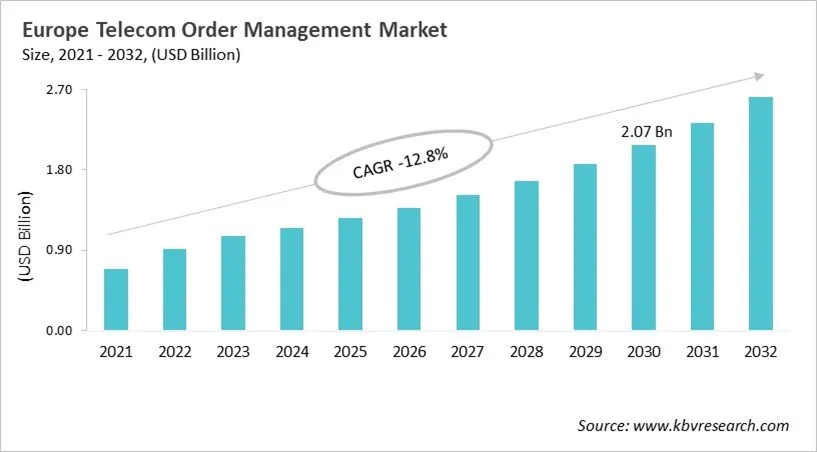
The European Telecom Order Management Market has quickly changed from manual, old-fashioned workflows to cloud-based, automated platforms. This is because of widespread digitalization, policy support, and the growth of next-generation networks. The European Commission and BEREC, two EU regulatory bodies, pushed for standardization, openness, and modernization. At the same time, programs like the Digital Agenda and Digital Decade sped up the use of cloud-native OSS/BSS. Operators like Vodafone, Orange, Telefónica, BT, and Deutsche Telekom were able to use AI-based order processing, unified product catalogs, and automated provisioning because they rolled out 4G, 5G, and large-scale FTTH. This digital shift now makes it possible for advanced services like network slicing, enterprise IoT, cloud-core integration, and edge connectivity.
Key trends like AI-driven order orchestration, microservices-based architectures, and omni-channel customer engagement models that make service activation faster and more open are also driving market growth. To reduce fallout and make customers happier, operators are using automation for predictive validation, real-time inventory assignment, and chatbot-assisted order capture. As cloud providers like AWS and Azure have more and more of an impact on deployment models, competition among top OEMs and ICT vendors like Ericsson, Nokia, Huawei, Netcracker, Amdocs, and others stays strong. In the changing telecom order management landscape in Europe, digitalization, automation depth, interoperability, and customer experience leadership are what set companies apart from their competitors.
Based on Network Type, the market is segmented into Wired, and Wireless. The Wired market segment dominated the Germany Telecom Order Management Market by Network Type is expected to grow at a CAGR of 8.9 % during the forecast period thereby continuing its dominance until 2032. Also, The Wireless market is anticipated to grow as a CAGR of 9.5 % during the forecast period during (2025 - 2032).
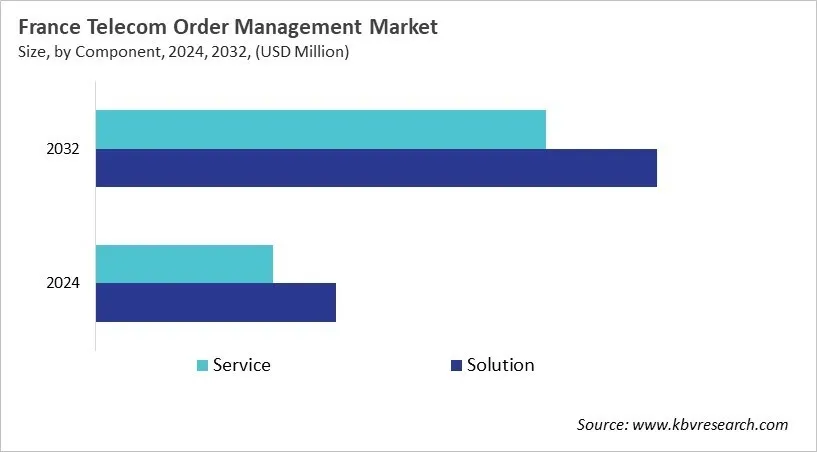
Based on Component, the market is segmented into Solution, and Service. With a compound annual growth rate (CAGR) of 11.4% over the projection period, the Solution Market, dominate the France Telecom Order Management Market by Component in 2024 and would be a prominent market until 2032. The Service market is expected to witness a CAGR of 12.6% during (2025 - 2032).
Free Valuable Insights: The Global Telecom Order Management Market will Hit USD 9.79 Billion by 2032, at a CAGR of 11.2%
Germany's telecom order management market is led by Deutsche Telekom, Vodafone Germany, and Telefónica O2 Germany. It is a mature and tightly regulated market. There is a growing focus on gigabit broadband, full 5G deployment, and the digital transformation of public services. Strong data protection rules that follow the GDPR, rules that protect consumers' rights, and government support for FTTH expansion all make it more important to have automated, scalable OMS platforms that can handle complicated migrations like moving from copper to fiber and providing converged services. Operators are updating OSS/BSS by using cloud-native, microservices-based architectures, unified product catalogs, and AI-driven validation to speed up activation and cut down on order fallout. Nokia, Ericsson, Amdocs, Netcracker, Oracle, and Huawei are all competitors. They all try to stand out by being able to comply with regulations, be flexible with integration, and manage hybrid-cloud orchestration. Regulatory intensity, digital transformation, and enterprise network demand are all still pushing OMS modernization across Germany.

By Network Type
By Component
By Deployment Mode
By Organization Size
By Country
Our team of dedicated experts can provide you with attractive expansion opportunities for your business.



 Unique Offerings