The Latin America, Middle East and Africa Blockchain Distributed Ledger Market is expected to reach $984.33 billion by 2027 and would witness market growth of 25.5% CAGR during the forecast period (2025-2032).
The Brazil market dominated the LAMEA Blockchain Distributed Ledger Market by Country in 2024, and would continue to be a dominant market till 2032; thereby, achieving a market value of $793.3 million by 2032. The Argentina market is registering a CAGR of 26% during (2025 - 2032). Additionally, The UAE market would showcase a CAGR of 24.4% during (2025 - 2032). The Brazil and UAE led the LAMEA Blockchain Distributed Ledger Market by Country with a market share of 27.8% and 15.4% in 2024. The South Africa market is expected to witness a CAGR of 26.8% during throughout the forecast period.
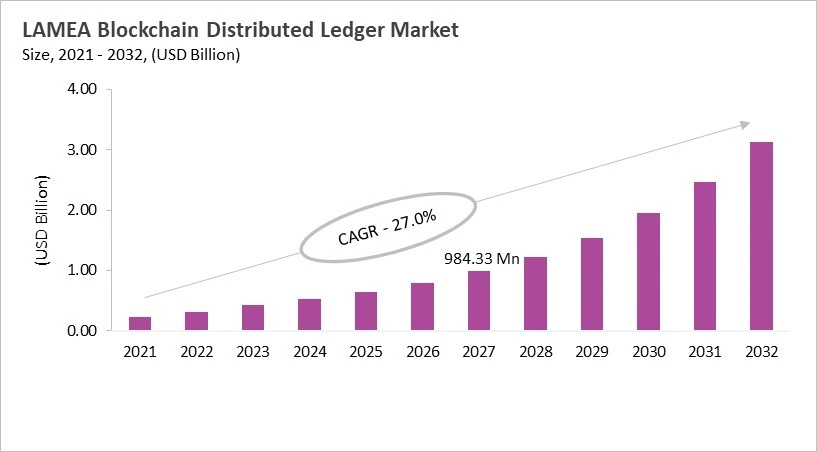
In the LAMEA region, blockchain use has grown from the early days of cryptocurrencies to well-organized national and regional digital transformation projects. In Latin America, the need for remittances and the economy's instability led to the development of blockchain-based financial tools. These tools were later supported by institutional platforms like LACChain, which was created by IDB Lab under the Inter-American Development Bank. The governments of the United Arab Emirates and Saudi Arabia added blockchain to their national digital strategies for trade and public administration in the Middle East. Policy pilots and innovation hubs have linked blockchain to financial inclusion, digital identity, and services that work on mobile devices across Africa.
Some of the most important trends are low-cost remittances that help people get access to money, more governments using blockchain for digital services and transparency, and the building of shared regional blockchain infrastructures. Leaders stress the importance of public-private partnerships, regulatory sandboxes, and moving beyond financial use cases to include supply chains, identity, and public records. Price isn't the only thing that affects competition. National digital strategies, regulatory readiness, and ecosystem maturity also play a role. Regional hubs are starting to form in markets with clearer rules and stronger institutions. In LAMEA, blockchain is moving from isolated pilots to ecosystem-based deployment that fits with modernization of the public sector and integration of businesses.
Based on Deployment, the market is segmented into Cloud, and On-premise. The Cloud market segment dominated the UAE Blockchain Distributed Ledger Market by Deployment is expected to grow at a CAGR of 24.6 % during the forecast period thereby continuing its dominance until 2032. Also, The On-premise market is anticipated to grow as a CAGR of 24 % during the forecast period during (2025 - 2032).
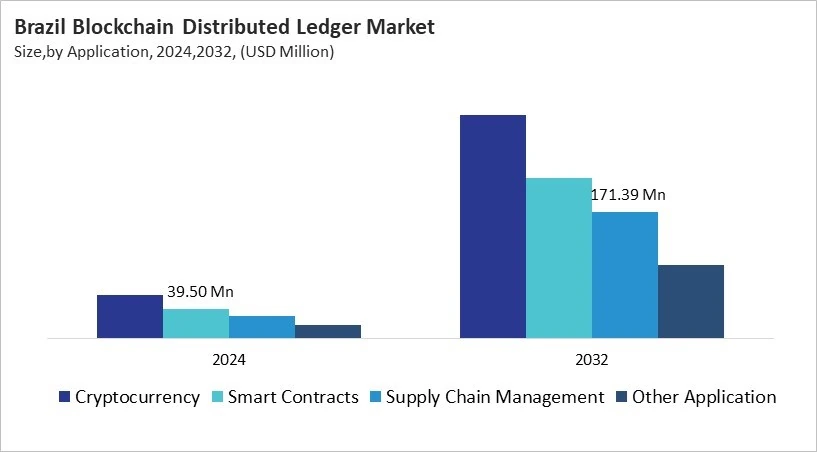
Based on Application, the market is segmented into Cryptocurrency, Smart Contracts, Supply Chain Management, and Other Application. Among various Brazil Blockchain Distributed Ledger Market by Application; The Cryptocurrency market achieved a market size of USD $58.2 Million in 2024 and is expected to grow at a CAGR of 23.2 % during the forecast period. The Supply Chain Management market is predicted to experience a CAGR of 24.8% throughout the forecast period from (2025 - 2032).
Free Valuable Insights: Blockchain Distributed Ledger Market Size Worth USD 30.56 billion by 2032
Brazil has built a dynamic blockchain and distributed ledger ecosystem thanks to government programs and private-sector testing. Public institutions and financial companies are using DLT to make finance and public administration more open, efficient, and secure for data. The Central Bank of Brazil has investigated blockchain for new ways to settle transactions and build digital currency infrastructure. This shows that institutions are becoming more confident in the technology. Digital identity, public services, and tokenized financial products are becoming more popular, according to market trends. Working together with banks, government agencies, universities, and global technology partners helps pilot projects and ecosystem growth. In competition, there are many players instead of just one main provider. Changes in regulations and efforts to create a central bank digital currency (CBDC) are likely to make more people use them. Brazil is using blockchain to make financial innovation and digital transformation across sectors happen.

By Deployment
By Ledger Type
By Application
By Country
Our team of dedicated experts can provide you with attractive expansion opportunities for your business.



 Unique Offerings