The Latin America, Middle East and Africa Desktop Virtualization Market would witness market growth of 11.8% CAGR during the forecast period (2025-2032).
The Brazil market dominated the LAMEA Desktop Virtualization Market by Country in 2024, and would continue to be a dominant market till 2032; thereby, achieving a market value of $812.2 million by 2032. The Argentina market is showcasing a CAGR of 12.8% during (2025 - 2032). Additionally, The UAE market would register a CAGR of 11% during (2025 - 2032). The Brazil and Argentina led the LAMEA Desktop Virtualization Market by Country with a market share of 24.8% and 5.5% in 2024. The South Africa market is expected to witness a CAGR of 12.7% during throughout the forecast period.
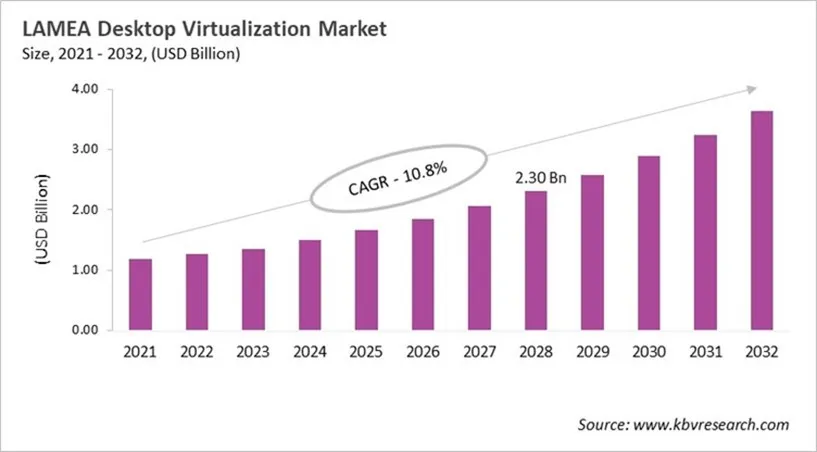
The LAMEA desktop virtualization market has grown steadily along with government-led digital transformation projects, the need for secure, centralized IT management across distributed workforces, and the modernization of businesses. Big companies and government agencies in Latin America, the Middle East, and Africa were the first to adopt it. National cloud policies and digital governance programs helped make it happen. The Middle East has become a high-growth area thanks to big investments in the cloud, the growth of regional data centers, and security frameworks. Latin America, on the other hand, has moved forward thanks to modernization in the public sector and the adoption of cloud by businesses. Digital inclusion strategies and the need to fix infrastructure problems have helped Africa grow, even though it has been slow. The COVID-19 pandemic sped up adoption even more by making remote work, education continuity, and cloud-based service delivery more common in the area.
The market is currently being shaped by the move toward cloud-based and hybrid desktop virtualization models, stricter cybersecurity rules, and more people working from home or in hybrid settings. Hybrid deployments help with data residency and compliance issues, especially in regulated industries like banking, energy, and government. Zero-trust security architectures, on the other hand, make systems safer against rising cyber threats. To meet the needs of different regions, top tech companies are focusing on expanding cloud footprints, optimizing performance, and hybrid integration. Global vendors, regional cloud providers, and telecom companies that offer localized solutions that follow national policies all have an effect on competition. Overall, the LAMEA desktop virtualization market is still growing because of things like the continued growth of the cloud, government digital agendas, and the need for workers to be flexible.
Based on Deployment Mode, the market is segmented into Cloud, and On-premise. The Cloud market segment dominated the UAE Desktop Virtualization Market by Deployment Mode is expected to grow at a CAGR of 11.2 % during the forecast period thereby continuing its dominance until 2032. Also, The On-premise market is anticipated to grow as a CAGR of 10.7 % during the forecast period during (2025 - 2032).
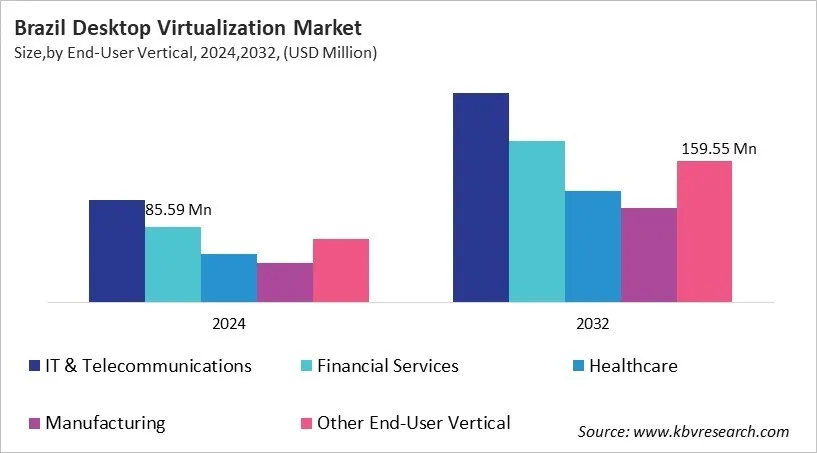
Based on End-User Vertical, the market is segmented into IT & Telecommunications, Financial Services, Healthcare, Manufacturing, and Other End-User Vertical. Among various Brazil Desktop Virtualization Market by End-User Vertical; The IT & Telecommunications market achieved a market size of USD $115.9 Million in 2024 and is expected to grow at a CAGR of 9.5 % during the forecast period. The Manufacturing market is predicted to experience a CAGR of 11.6% throughout the forecast period from (2025 - 2032).
Free Valuable Insights: The Worldwide Desktop Virtualization Market is Projected to reach USD 29.02 Billion by 2032, at a CAGR of 10.4%
Brazil's desktop virtualization market is growing along with the country's digital economy. This is thanks to more people using the cloud, more focus on cybersecurity, and government-led digital transformation projects. More and more businesses in important fields are using virtualization to make IT management easier, improve data security in accordance with LGPD rules, and make hybrid work models more flexible through cloud and Desktop-as-a-Service deployments. Global providers are putting money into cloud and data center infrastructure to make it easier to scale up. At the same time, hybrid cloud architectures are becoming more important to virtual desktop strategies. Industries that require a lot of education and knowledge are also using virtual desktops to improve access, performance, and cost-effectiveness. Even though there are problems with infrastructure gaps, the availability of skilled workers, and moving old systems, competition between global vendors and local service providers keeps driving innovation toward solutions that are safe, scalable, and cost-effective.

By Deployment Mode
By Desktop Delivery Platform
By End-User Vertical
By Country
Our team of dedicated experts can provide you with attractive expansion opportunities for your business.




 Unique Offerings