“Global 3D NAND Flash Memory Market to reach a market value of USD 101.63 Billion by 2032 growing at a CAGR of 22.2%”
The Global 3D NAND Flash Memory Market size is expected to reach $101.63 billion by 2032, rising at a market growth of 22.2% CAGR during the forecast period.
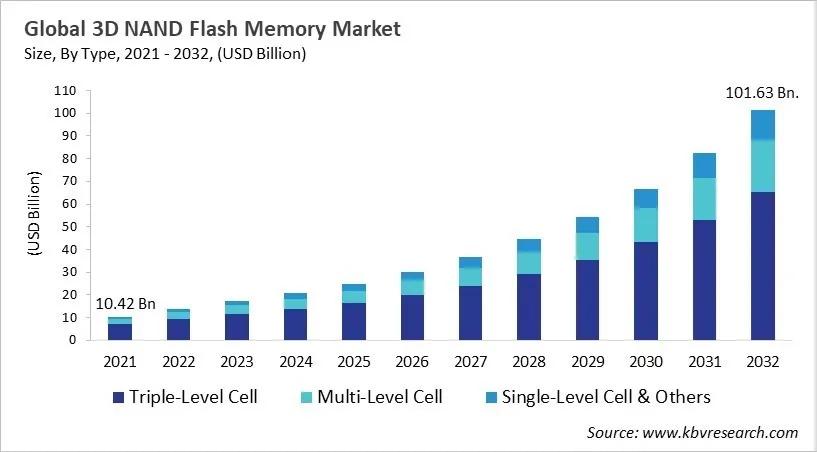
The global 3D NAND flash memory market has evolved because more and more people want non-volatile storage that is bigger, faster, and cheaper, thanks to applications that use a lot of data. When planar NAND hit physical scaling limits, the industry moved to three-dimensional architectures. Samsung's commercial release of 3D V-NAND in 2013 led the way. OEMs got around problems with density and endurance by stacking memory cells on top of each other. This made it possible for layer counts, performance, and power efficiency to improve quickly from generation to generation. Samsung, Kioxia (with SanDisk), Micron, and SK hynix are some of the biggest companies that have kept improving the technology with new ideas like hybrid bonding and multi-stack architectures. 3D NAND is the technology behind modern SSDs in smartphones, PCs, data centers, and new applications. Industry roadmaps aim for devices with 400 or more layers to support future data growth while keeping energy efficiency.
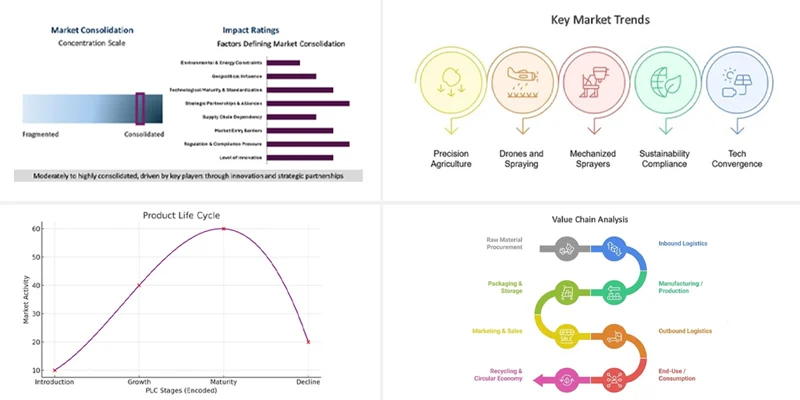
Vertical scaling, advanced bonding and interface technologies, and new end-use applications are all big trends in the market right now. Increasing layer counts make storage denser and allow for high-capacity SSDs for hyperscale data centers, AI workloads, and edge computing. Hybrid bonding also speeds up I/O for the next generation of PCIe standards. Enterprise storage, cloud infrastructure, automotive electronics, and AI-driven systems are driving demand more and more, along with a focus on power efficiency and reliability. Market leaders focus on ongoing generational innovation, partnerships and joint ventures, big investments in manufacturing capacity, and branching out into niche areas like automotive and industrial storage. The competitive landscape is still very concentrated, with high capital and technical barriers keeping established OEMs at the top as competition focuses on cost per bit, performance per watt, and supply chain resilience.
The COVID-19 pandemic had a major adverse impact on the 3D NAND flash memory market, especially in the beginning when global lockdowns stopped semiconductor manufacturing and forced temporary shutdowns of fabrication and assembly facilities. These problems made it harder to make things, slowed down capacity expansions, and made it harder to get important raw materials and parts. Logistics problems also had a big impact on international supply chains, causing delays in the delivery of wafers, chemicals, and equipment. On the demand side, slowdowns in important end-use industries and less spending by consumers made smartphones, PCs, and embedded storage solutions less popular. This caused prices to fluctuate and margins to shrink. Also, because of uncertainty in the economy, companies put off making capital investments and upgrading their technology, which slowed down innovation and market growth as a whole. Thus, the COVID-19 pandemic had a negative impact on the market.

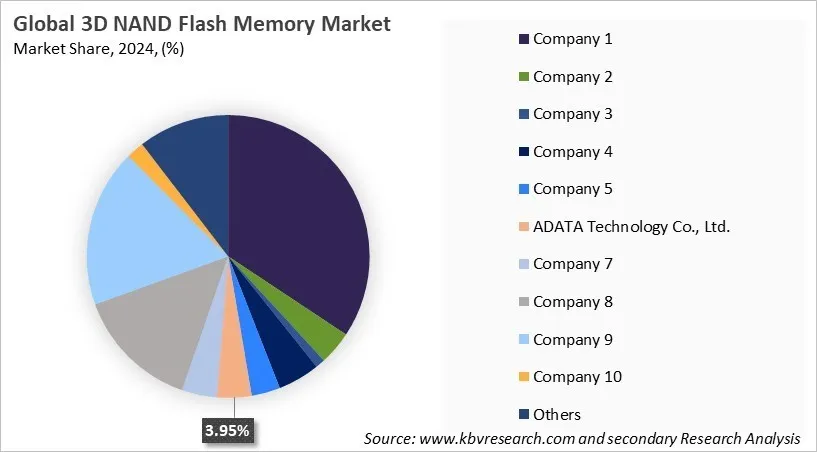
The leading players in the market are competing with diverse innovative offerings to remain competitive in the market. The above illustration shows the percentage of revenue shared by some of the leading companies in the market. The leading players of the market are adopting various strategies in order to cater demand coming from the different industries. The key developmental strategies in the market are Acquisitions, and Partnerships & Collaborations.
Based on Type, the market is segmented into Triple-Level Cell, Multi-Level Cell, and Single-Level Cell & Others. The Multi-Level Cell segment attained 22% revenue share in the market in 2024. The Multi-Level Cell segment in the 3D NAND Flash Memory Market is characterized by its capability to store multiple bits of information in each memory cell, offering a practical balance between storage density and performance. This segment is widely used in consumer electronics, solid-state drives, and mobile devices, where moderate storage capacities and reliable performance are essential.
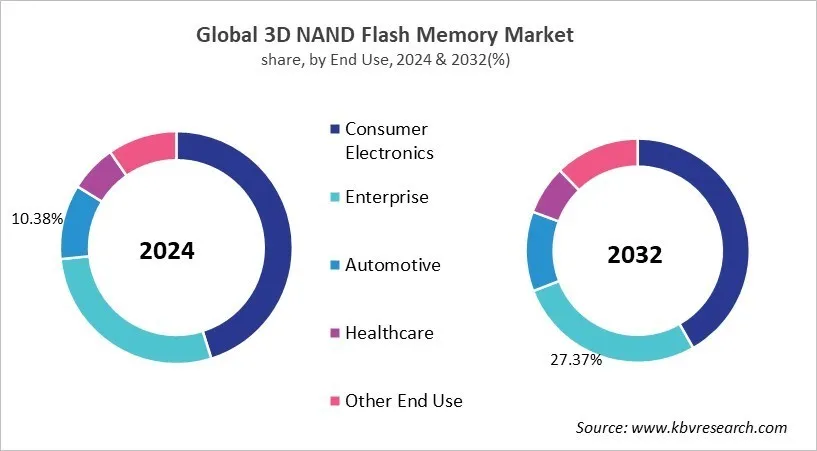
Based on End Use, the market is segmented into Consumer Electronics, Enterprise, Automotive, Healthcare, and Other End Use. The Enterprise segment attained 29% revenue share in the market in 2024. The Enterprise segment of the 3D NAND Flash Memory Market focuses on high-performance storage solutions for data centers, servers, cloud computing infrastructure, and enterprise-grade storage systems. Memory solutions in this segment are optimized for speed, reliability, endurance, and scalability, supporting critical business operations and large-scale data management.
Free Valuable Insights: 3D NAND Flash Memory Market size to reach USD 101.63 Billion by 2032
Region-wise, the 3D NAND Flash Memory Market is analyzed across North America, Europe, Asia Pacific, and LAMEA. The Asia Pacific segment recorded 46% revenue share in the market in 2024. Hyperscale data centers, cloud service providers, enterprise IT, and advanced automotive and industrial applications are driving the 3D NAND flash memory market in North America and Europe. These areas benefit from being the first to use high-performance SSDs to support AI, big data analytics, and next-generation enterprise workloads. This speeds up the shift to higher-layer-count 3D NAND and more advanced interface technologies like PCIe Gen5 and beyond. In these markets, OEM strategies focus on reliability, energy efficiency, and meeting strict data and automotive standards. At the same time, ongoing investments in research and development and advanced manufacturing help maintain technological leadership. 3D NAND is a key part of expanding digital infrastructure in North America and Europe because there are big cloud ecosystems and businesses are spending a lot of money.
In Asia Pacific and LAMEA, the 3D NAND flash memory market is shaped by manufacturing leadership, growing digital economies, and a growing need for high-density storage that doesn't cost a lot. OEMs like Samsung, SK hynix, Kioxia, and Micron lead the way in production and innovation in Asia Pacific. This is true across consumer electronics, smartphones, and rapidly growing data center infrastructure. In LAMEA, the market is growing because more people are using the cloud, the government is pushing for digital transformation, and businesses and telecom companies need more storage space. Scalable 3D NAND solutions make things more affordable, help infrastructure grow, and meet new needs in mobility, automotive electronics, and edge computing. This will lead to steady long-term market growth in both regions.
| Report Attribute | Details |
|---|---|
| Market size value in 2025 | USD 24.98 Billion |
| Market size forecast in 2032 | USD 101.63 Billion |
| Base Year | 2024 |
| Historical Period | 2021 to 2023 |
| Forecast Period | 2025 to 2032 |
| Revenue Growth Rate | CAGR of 22.2% from 2025 to 2032 |
| Number of Pages | 519 |
| Number of Tables | 384 |
| Report coverage | Market Trends, Revenue Estimation and Forecast, Segmentation Analysis, Regional and Country Breakdown, Market Share Analysis, Porter’s 5 Forces Analysis, Company Profiling, Companies Strategic Developments, SWOT Analysis, Winning Imperatives |
| Segments covered | Type, Application, End Use, Region |
| Country scope |
|
| Companies Included | Samsung Electronics Co., Ltd. (Samsung Group), Powerchip Semiconductor Manufacturing Corporation, Infineon Technologies AG, Kingston Technology Company, Inc., Transcend Information, Inc., ADATA Technology Co., Ltd., Seagate Technology LLC, Micron Technology, Inc., SK hynix, Inc., and Macronix International Co., Ltd. |
By Type
By Application
By End Use
By Geography
This Market size is expected to reach USD 101.63 Billion by 2032.
The 3D NAND flash memory market is projected to grow at a CAGR of 22.2% between 2025 and 2032.
Exponential growth in global digital data generation and storage demand supported by advances in 3D NAND technology from leading OEMs.
Samsung Electronics Co., Ltd. (Samsung Group), Powerchip Semiconductor Manufacturing Corporation, Infineon Technologies AG, Kingston Technology Company, Inc., Transcend Information, Inc., ADATA Technology Co., Ltd., Seagate Technology LLC, Micron Technology, Inc., SK hynix, Inc., and Macronix International Co., Ltd.
The Smartphones & Tablets segment led the maximum revenue in the Global 3D NAND Flash Memory Market by Application in 2024, thereby, achieving a market value of $32.7 billion by 2032.
The Asia Pacific region dominated the Global 3D NAND Flash Memory Market by Region in 2024, and would continue to be a dominant market till 2032; thereby, achieving a market value of $47.6 billion by 2032.
Our team of dedicated experts can provide you with attractive expansion opportunities for your business.






 Unique Offerings