“Global Cloud Orchestration Market to reach a market value of USD 70.37 Billion by 2032 growing at a CAGR of 14.8%”
The Global Cloud Orchestration Market size is estimated at $26.79 billion in 2025 and is expected to reach $70.37 billion by 2032, rising at a market growth of 14.8% CAGR during the forecast period (2025-2032). The growth of this market is justified by rapid enterprise cloud adoption, increasing hybrid and multi-cloud deployments, rising demand for automated workload management, cost optimization, and scalability.
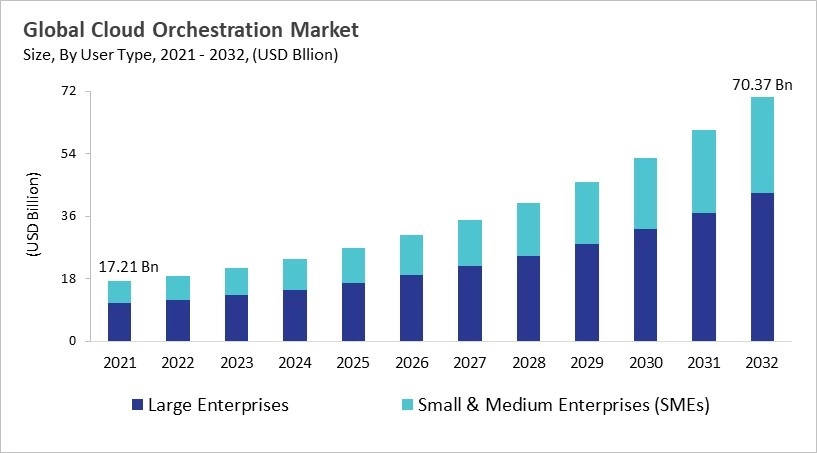
Cloud orchestration is the automated management and coordination of cloud resources, applications, and workflows to deliver consistent business outcomes with minimal manual effort. Advances in infrastructure-as-code (IaC), DevOps, and declarative automation shifted orchestration into a core IT capability, allowing infrastructure and application workflows to be deployed, defined, and governed as code. With enterprises adopting agile delivery models, cloud-native architectures, and CI/CD pipelines, orchestration developed from simple automation scripts into a central element of modern digital transformation, supporting scalability, reliability, and operational consistency across diverse cloud environments.
The cloud orchestration market is driven by hybrid and multi-cloud strategies, smart automation, and embedded governance. Organisations largely rely on orchestration frameworks that enforce policy enforcement, unify deployment, compliance, and security across on-premises and public cloud systems. Declarative workflows and IaC integrate orchestration directly into DevOps pipelines, while developing AI-based orchestration allows cost optimization, predictive scaling, and adaptive decision-making. Market players like Google Cloud, Microsoft Azure, and AWS are leading the market through integrated native orchestration services, multi-cloud and hybrid control planes, and support for open standards such as Terraform and Kubernetes.
The major strategies followed by the market participants are Partnerships as the key developmental strategy to keep pace with the changing demands of end users. For instance, In February, 2025, Cisco Systems, Inc. teamed up with Nvidia, a computer manufacturer corporation to streamline enterprise AI adoption. Cisco’s Silicon One will integrate with Nvidia’s Spectrum-X platform, creating a unified, AI-ready data center architecture. The collaboration aims to simplify network management, enhance performance, and provide customers with scalable, validated AI infrastructure solutions. Moreover, In March, 2025, Hewlett Packard Enterprise Company announced the partnership with Spark New Zealand, a telecommunications company to enhance its IT infrastructure through HPE GreenLake hybrid cloud. This partnership aims to reduce IT costs, improve operational efficiency, and integrate automation and AI. Spark will implement HPE’s GreenLake hybrid cloud management, leveraging HPE's global services and AI capabilities.
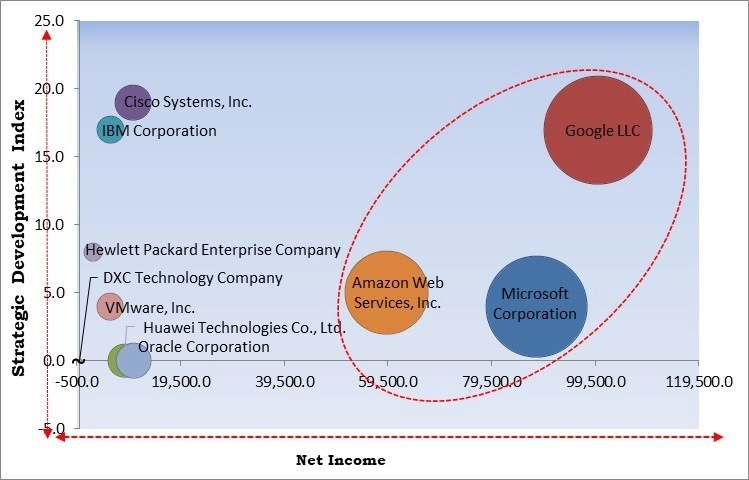
Based on the Analysis presented in the KBV Cardinal matrix; Google LLC, Microsoft Corporation, and Amazon Web Services, Inc. are the forerunners in the Cloud Orchestration Market. In April, 2025, Microsoft Corporation announced the partnership with UiPath, a software company to integrate Microsoft Copilot Studio with UiPath Studio, enhancing enterprise automation. This integration allows developers to embed UiPath agents into Copilot Studio and vice versa, enabling seamless orchestration and process automation across Microsoft 365 apps and external systems, improving workflow efficiency. Companies such as Oracle Corporation, Cisco Systems, Inc., and Huawei Technologies Co., Ltd. are some of the key innovators in Cloud Orchestration Market.
As businesses quickly switched to remote work and digital-first operating models during the COVID-19 pandemic, the use of cloud orchestration solutions grew much faster. Because businesses depend on cloud-based infrastructure to keep running, the need for automated deployment, management, and scaling of resources across multi-cloud and hybrid environments has grown. More digital transformation projects in areas like BFSI, healthcare, retail, and IT services led to a greater need for orchestration tools that can handle containers, microservices, and distributed applications with little or no help from people. At the same time, spending on DevOps and automation went up. Cloud orchestration made CI/CD processes faster, systems more resilient, and resource use more efficient. The pandemic also pushed businesses to make long-term, scalable cloud plans, which led to more investment in orchestration platforms to improve operational efficiency, manage costs, and control workloads from a single location. Thus, the COVID-19 pandemic had a positive impact on the market.

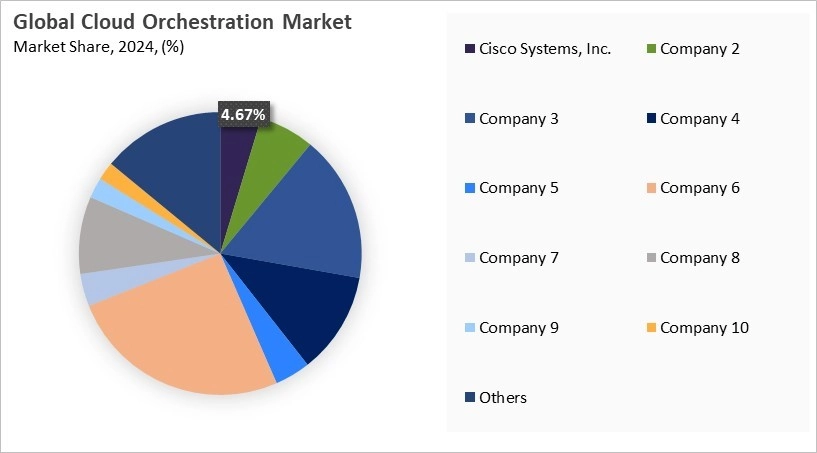
The leading players in the market are competing with diverse innovative offerings to remain competitive in the market. The above illustration shows the percentage of revenue shared by some of the leading companies in the market. The leading players of the market are adopting various strategies in order to cater demand coming from the different industries. The key developmental strategies in the market are Acquisitions, and Partnerships & Collaborations.
Based on User Type, the market is segmented into Large Enterprises and Small & Medium Enterprises (SMEs). The Small & Medium Enterprises (SMEs) segment acquired 37% revenue share in the market in 2024. The Small and Medium Enterprises (SMEs) segment in the Cloud Orchestration Market includes organizations that are smaller in scale but increasingly rely on cloud technologies to drive growth and operational efficiency. SMEs face challenges such as limited IT resources, budget constraints, and the need to scale quickly without compromising performance.
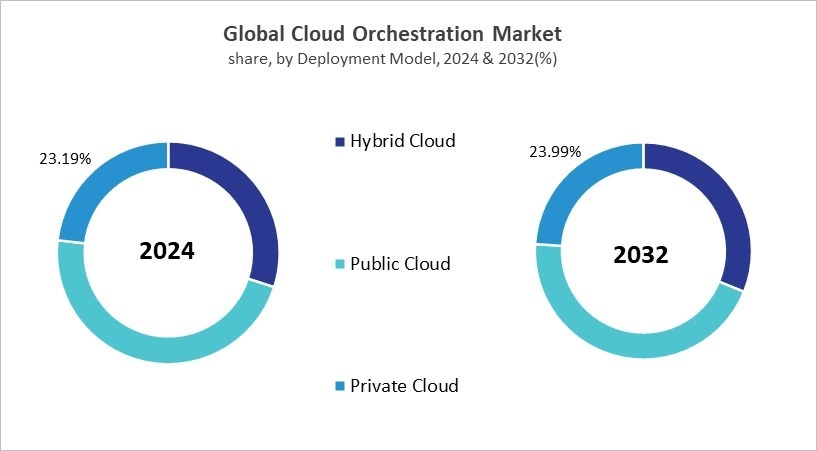
Based on Deployment Model, the market is segmented into Hybrid Cloud, Public Cloud and Private Cloud. The Hybrid Cloud segment attained 30% revenue share in the market in 2024. The Hybrid Cloud segment in the Cloud Orchestration Market represents a combination of private and public cloud infrastructures, allowing organizations to leverage the benefits of both environments. Cloud orchestration in hybrid deployments ensures seamless management and coordination of workloads across multiple platforms, enabling businesses to move data and applications efficiently between on-premises systems and public cloud services.
Free Valuable Insights: Cloud Orchestration Market Size to reach $70.37 by 2032
Region-wise, the Cloud Orchestration Market is analyzed across North America, Europe, Asia Pacific, and LAMEA. The North America segment recorded 38% revenue share in the market in 2024. The cloud orchestration market is anticipated to grow at a significant rate in the North America and Europe regions. This is because of early adoption of cloud technologies, the presence of major hyperscalers and enterprise adopters, and well-established IT infrastructure. The growth is further driven by heavy investments in automation, multi-cloud and hybrid strategies, and advanced orchestration solutions across industries like healthcare, BFSI, and IT. Also, Canada contributes to regional growth as enterprises largely digitalize operations and integrate orchestration into digital transformation initiatives. Additionally, Europe cloud orchestration market is predicted to expand at a prominent rate. The market expansion is supported by strong cloud adoption across industries and regulatory emphasis on data privacy, protection, and compliance, which shapes orchestration requirements. Regional nations are largely deploying cloud orchestration to improve operational efficiency, security, and governance.
In the Asia Pacific and LAMEA region, the cloud orchestration market is expected to capture expansion during the forecast period. This is due to expanding cloud infrastructure, rising enterprise demand in nations such as Japan, India, China, and Australia, and supportive government initiatives. The region’s growth is showcasing accelerated adoption of hybrid and multi-cloud environments, scalable orchestration platforms, and IoT integration across enterprises. Furthermore, the LAMEA cloud orchestration market is expected to expand at a steady rate. The market is driven by surging digital transformation in developing nations. Latin American nations like Brazil are modernizing IT ecosystems, and the Middle East and Africa are investing in cloud projects to support government digital services, enterprises automation, and e-commerce. The LAMEA cloud orchestration market is expanding due to enhanced infrastructure and rising awareness of orchestration benefits.
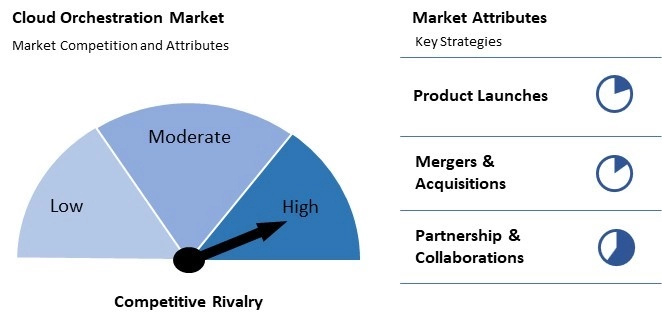
The Cloud Orchestration Market is very competitive because technology is changing quickly, and more people want automated, scalable cloud solutions. To stay ahead of the competition, market players focus on new ideas, strategic partnerships, and making their services stand out. The competition is focused on providing orchestration platforms that are flexible, safe, and cheap, with a strong emphasis on multi-cloud and hybrid cloud features. Solutions that focus on the customer and constant improvements to the platform's efficiency are two important factors that affect the market. This creates a fast-paced environment where being flexible and having technological leadership are key to success.
| Report Attribute | Details |
|---|---|
| Market size value in 2025 | USD 26.79 Billion |
| Market size forecast in 2032 | USD 70.37 Billion |
| Base Year | 2024 |
| Historical period | 2021 to 2023 |
| Forecast Period | 2025 to 2032 |
| Revenue Growth Rate | CAGR of 14.8% from 2025 to 2032 |
| Number of Pages | 641 |
| Tables | 498 |
| Report Coverage | Market Trends, Revenue Estimation and Forecast, Segmentation Analysis, Regional and Country Breakdown, Competitive Landscape, Market Share Analysis, Porter’s 5 Forces Analysis, Company Profiling, Companies Strategic Developments, SWOT Analysis, Winning Imperatives |
| Segments Covered | User Type, Deployment Model, Solution, Industry Vertical, Region |
| Country Scope |
|
| Companies Included | Cisco Systems, Inc., IBM Corporation, Microsoft Corporation, Google LLC (Alphabet Inc.), Oracle Corporation, Amazon Web Services, Inc. (Amazon.com, Inc.), Hewlett Packard Enterprise Company, VMware, Inc. (Broadcom Inc.), Huawei Technologies Co., Ltd. (Huawei Investment & Holding Co., Ltd.), and DXC Technology Company |
By User Type
By Deployment Model
By Solution
By Industry Vertical
By Geography
Our team of dedicated experts can provide you with attractive expansion opportunities for your business.







 Unique Offerings