“Global Cognitive Radio Market to reach a market value of USD 27.94 Billion by 2032 growing at a CAGR of 15%”
The Global Cognitive Radio Market size is expected to reach $27.94 billion by 2032, rising at a market growth of 15.0% CAGR during the forecast period.
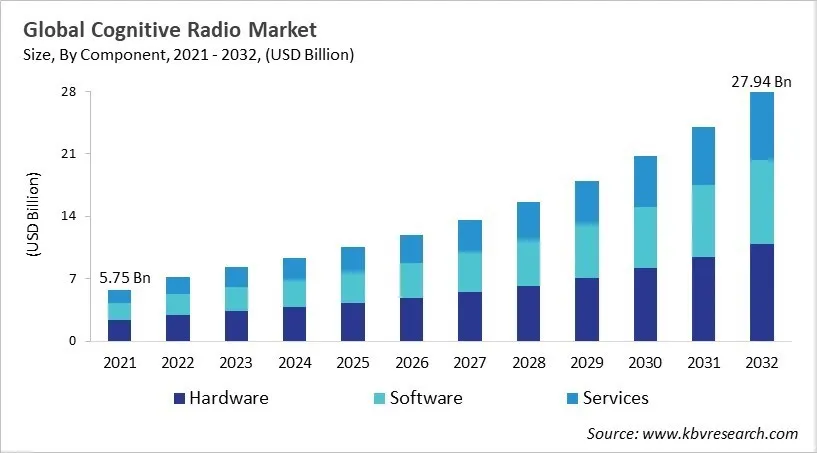
The cognitive radio developed to bridge the gap between increasing wireless demand and limited spectrum availability, has evolved into today’s smart, AI-enabled communication system. With time, dynamic spectrum access has expanded into broader notions of learning-enabled, adaptive radios supported by defence initiatives, government programmes, and OEM research. With the accelerated wireless traffic, cognitive radio transformed from a defence and academic concept into commercial relevance, shaped by the requirements for efficient spectrum usage in largely dense networks. Key market trends include the convergence of cognitive radio with 5G/6G and IoT ecosystems, integration of AI/ML from decision making, and smarter sensing, and regulatory movements toward flexible spectrum sharing environments.
Key market players, especially in defence communications are largely investing in AI-enabled radio technology, research & development, and reconfigurable and software-defined platforms. Leading players are adopting strategies including partnerships, innovation, government contract acquisition, and vertical specialization across industries like public safety, smart-infrastructure networks, and tactical communications. The competitive landscape of cognitive radio market spans research-driven firms, along with defence contractors. Competition in market is shaped by regulatory change, technology evolution, and rising importance of cognitive engines in modern wireless architectures. The developing players are positioning themselves through rapid innovation, thereby raising competition in market with success depending on how well companies adapt to changing network demands and spectrum policy.
The COVID-19 pandemic had a big effect on the cognitive radio market because lockdowns stopped manufacturing and research and development, which slowed down production, caused shortages of parts, and made shipping take longer. Lowered capital spending in the telecom, defense, and public safety sectors made demand even weaker, putting off planned deployments and technology upgrades. Research institutions also had limited resources, which slowed down testing and new ideas in areas like dynamic spectrum access. Problems in the supply chain caused prices to go up and down and made deliveries harder, which caused projects to be delayed or canceled. In general, the market slowed down a lot, and it only started to pick up again when global supply chains stabilized and economic activity started up again. Thus, the COVID-19 pandemic had a Negative impact on the market.

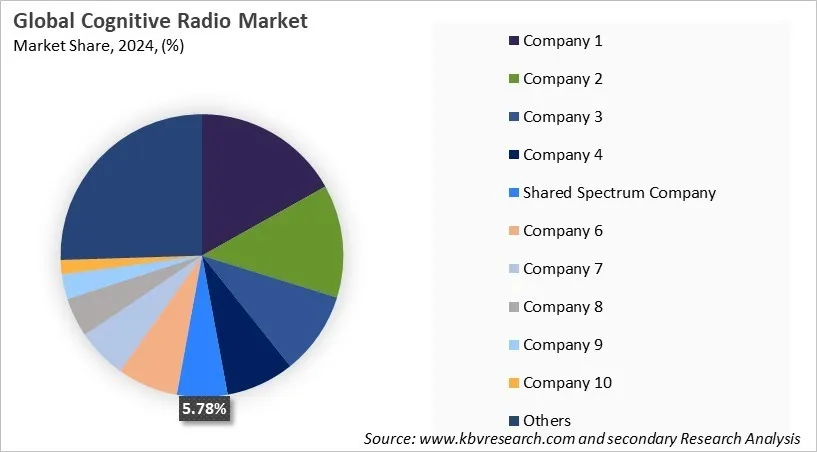
The leading players in the market are competing with diverse innovative offerings to remain competitive in the market. The above illustration shows the percentage of revenue shared by some of the leading companies in the market. The leading players of the market are adopting various strategies in order to cater demand coming from the different industries. The key developmental strategies in the market are Acquisitions, and Partnerships & Collaborations.
Based on Component, the market is segmented into Hardware, Software and Services. The software segment attained 33% revenue share in the cognitive radio market in 2024. The software component forms the intelligence layer of cognitive radio systems, enabling spectrum analysis, learning algorithms, modulation adaptation, and decision-making functions that allow radios to operate autonomously. This includes AI-based spectrum-management tools, signal-classification engines, interference-avoidance algorithms, and network-optimization platforms.
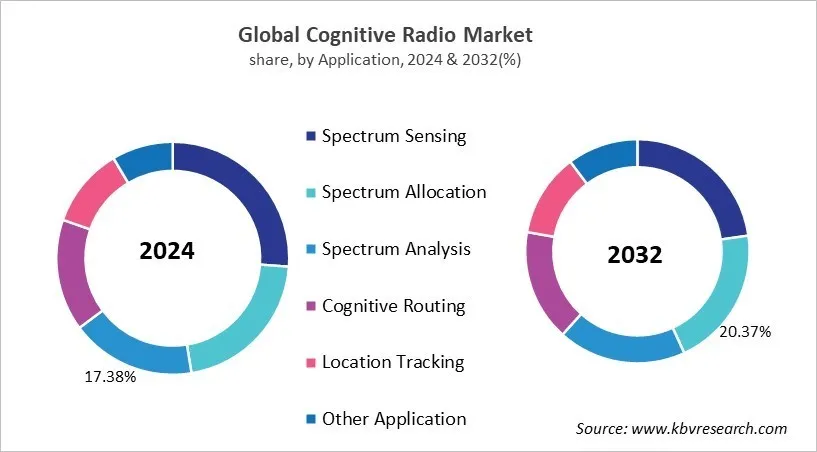
Based on Application, the market is segmented into Spectrum Sensing, Spectrum Allocation, Spectrum Analysis, Cognitive Routing, Location Tracking and Other Application. The spectrum allocation segment gained 21% revenue share in the cognitive radio market in 2024. Spectrum allocation within cognitive radio frameworks enables dynamic and intelligent assignment of frequency bands based on real-time conditions. This application helps maximize the utility of available spectrum by allowing devices to shift frequencies autonomously depending on user demand, network load, and environmental factors.
Free Valuable Insights: Cognitive Radio Market size to reach USD 27.94 Billion by 2032
Region-wise, the Cognitive Radio Market is analyzed across North America, Europe, Asia Pacific, and LAMEA. The North America segment recorded 35% revenue share in the Cognitive Radio Market in 2024. In North America and Europe, the cognitive radio market is anticipated to grow at a substantial rate during the forecast period. The market is majorly driven by strong regulatory momentum towards dynamic spectrum access, advanced defence communication requirements, and rapid integration of AI-driven wireless systems. North America, particularly the US, benefits from DARPA-linked innovation, significant defence spending, and early adoption of software-defined radio platforms and active spectrum-sharing policy initiatives. This results in a well-established ecosystem with prominent contribution from telecom operators, defence contractors, and research institutions. Moreover, Europe market is experiencing expansion backed by emphasis on harmonised spectrum regulations, strong OEM engagement, and 5G/6G testbeds, especially across public-safety communications, aerospace, and cross-border spectrum-management frameworks. Both North America, and Europe are characterized by established standard bodies, large R&D investments, and commercialization of AI-enabled cognitive radio capabilities.
The cognitive radio market is witnessing prominent growth in Asia Pacific and LAMEA region. The APAC region, led by India, South Korea, China and Japan, is experiencing strong demand because of dense urban networks, 5G/6G infrastructure expansion, massive IoT deployments, and massive IoT deployments. Regional governments largely support dynamic spectrum strategies, accelerating interest in cognitive radios for industrial automation, and congestion management. Additionally, LAMEA is also promising market, where adoption is driven by expanding public-safety modernization, telecom-infrastructure, and defence-oriented projects. The growth opportunities rise with nations modernizing spectrum policy and seeking cost-effective solutions for spectrum scarcity. In both the regions, the cognitive radio market is shaped by the requirement of flexible, adaptive wireless systems.
| Report Attribute | Details |
|---|---|
| Market size value in 2025 | USD 10.50 Billion |
| Market size forecast in 2032 | USD 27.94 Billion |
| Base Year | 2024 |
| Historical Period | 2021 to 2023 |
| Forecast Period | 2025 to 2032 |
| Revenue Growth Rate | CAGR of 15.0% from 2025 to 2032 |
| Number of Pages | 513 |
| Number of Tables | 391 |
| Report coverage | Market Trends, Revenue Estimation and Forecast, Segmentation Analysis, Regional and Country Breakdown, Market Share Analysis, Porter’s 5 Forces Analysis, Company Profiling, Companies Strategic Developments, SWOT Analysis, Winning Imperatives |
| Segments covered | Component, End Use, Application, Region |
| Country scope |
|
| Companies Included | BAE Systems PLC, RTX Corporation, Thales Group S.A., Rohde & Schwarz GmbH & Co. KG, Shared Spectrum Company, L3Harris Technologies, Inc., Huawei Technologies Co., Ltd. (Huawei Investment & Holding Co., Ltd.), General Dynamics Mission Systems, Inc. (General Dynamics Corporation), Vecima Networks Inc., and Wipro Limited |
By Component
By End Use
By Application
By Geography
The market size is projected to reach USD 27.94 Billion by 2032.
The cognitive radio market is projected to grow at a CAGR of 15% between 2025 and 2032.
Acute spectrum scarcity driving better utilization amid expanding 5G/6G, IoT, and massive connectivity demands.
BAE Systems PLC, RTX Corporation, Thales Group S.A., Rohde & Schwarz GmbH & Co. KG, Shared Spectrum Company, L3Harris Technologies, Inc., Huawei Technologies Co., Ltd. (Huawei Investment & Holding Co., Ltd.), General Dynamics Mission Systems, Inc. (General Dynamics Corporation), Vecima Networks Inc., and Wipro Limited
The Telecommunication segment led the maximum revenue in the Global Cognitive Radio Market by End Use in 2024, thereby, achieving a market value of $10.7 billion by 2032.
The North America region dominated the Global Cognitive Radio Market by Region in 2024, and would continue to be a dominant market till 2032; thereby, achieving a market value of $9.3 billion by 2032.
Our team of dedicated experts can provide you with attractive expansion opportunities for your business.







 Unique Offerings