“Global Computer Aided Manufacturing Software Market to reach a market value of USD 5.49 Billion by 2032 growing at a CAGR of 9.3%”
The Global Computer Aided Manufacturing Software Market size is estimated at $2.94 billion in 2025 and is expected to reach $5.49 billion by 2032, rising at a market growth of 9.3% CAGR during the forecast period (2025-2032). This growth is driven by increasing automation in manufacturing, adoption of Industry 4.0 technologies, rising demand for precision engineering, and integration of AI and IoT in production processes.
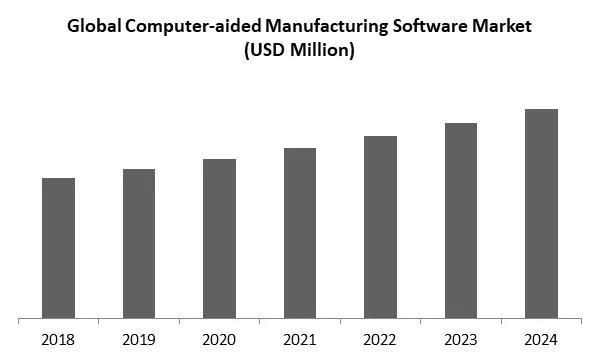
Computer-aided manufacturing software has developed from early numerical-control toolpath generators into a crucial pillar of digital manufacturing. Originally designed to convert CAD geometry into CNC instructions for basic machining, CAM matured into CAM/CAD environments that reduced manual coding and enabled a continuous digital flow. With the growth of Industry 4.0, CAM became a key factor of the digital thread, propelling collision detection, simulation, and process optimization while production planning, connecting design and execution. The scope has expanded beyond traditional subtractive machining to include high-speed, multi-axis, additive, and hybrid manufacturing, positioning CAM as a core enabler of resilient manufacturing strategies globally.
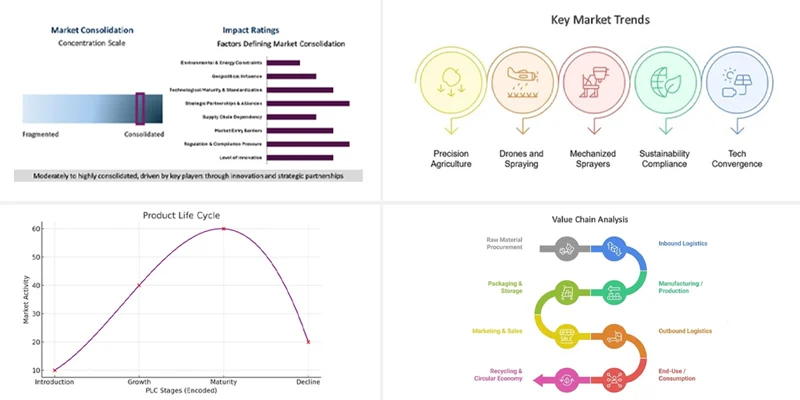
CAM is largely embedded in cloud-enabled, connected, and AI-assisted manufacturing ecosystems. Integration with PLM, MES, and IIoT platforms enables digital twins, closed-loop optimization, and real-time feedback from machines, while hybrid and cloud deployments enhance collaboration and accessibility for manufacturers. Providers are pursuing end-to-end platform strategies, ecosystem-centric business models, and deep industry verticalization that combine machine-tool partnerships, software, and skill development. The CAM software market is moderately concentrated around large multinational providers complemented by niche specialists, reflecting CAM’s transformation from a specialist programming tool into a data-driven, smart decision engine for modern manufacturing.

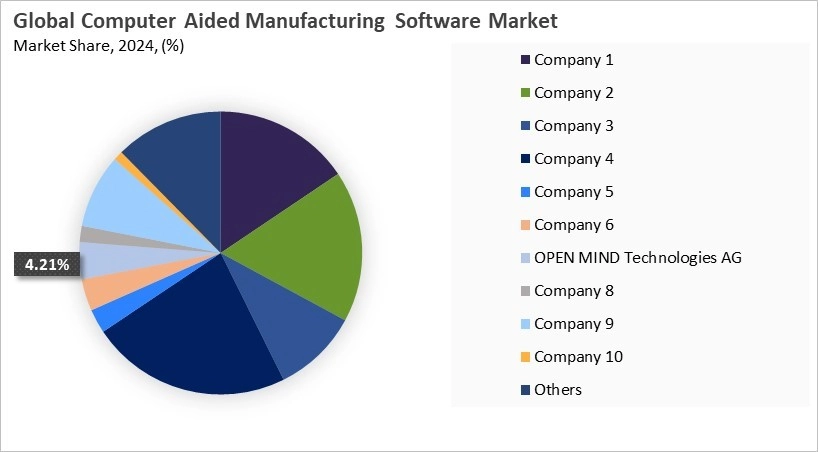
The leading players in the market are competing with diverse innovative offerings to remain competitive in the market. The above illustration shows the percentage of revenue shared by some of the leading companies in the market. The leading players of the market are adopting various strategies in order to cater demand coming from the different industries. The key developmental strategies in the market are Acquisitions, and Partnerships & Collaborations.
The COVID-19 pandemic first harmed demand for Computer-Aided Manufacturing (CAM) software around the world. Lockdowns and interruptions in the automotive, aerospace, and other discrete manufacturing sectors caused technology investments to be put on hold, capital spending to drop, and upgrade projects to be put on hold, especially for on-premises, hardware-intensive deployments. Supply chain problems made it even harder to adopt, which led to lower market projections for 2028 than what was expected before the pandemic. The crisis did speed up some changes that will help CAM in the medium term, though. These include the use of cloud-based solutions, remote programming, digital-twin simulations, and virtual training. The larger CAD/CAM ecosystem benefited from more online collaboration and digital design-to-manufacturing workflows. This led to more people using the software as industries adapted and economies reopened. So, even though COVID-19 caused problems in the short term, it sped up the long-term growth and modernization of the global CAM software market. Thus, the COVID-19 had a negative impact on this market.
Based on Deployment Mode, the market is segmented into On-premise and Cloud-based / SaaS. The cloud-based / SaaS segment attained 36% revenue share in the computer aided manufacturing software market in 2024. Cloud CAM adoption is being driven by small and mid-sized enterprises, design-centric manufacturers, and new production facilities seeking to reduce upfront IT costs and improve scalability. Cloud-based solutions enable easier collaboration, faster updates, and access to advanced CAM capabilities without heavy infrastructure investment.
Based on Software Type, the market is segmented into Integrated, Standalone and Cloud. The standalone segment recorded 37% revenue share in the computer aided manufacturing software market in 2024. Standalone solutions are widely used by small and mid-sized enterprises, job shops, and specialized machining facilities that require robust CAM functionality without the complexity or cost of full platform integration. Their flexibility, compatibility with diverse CAD systems and CNC machines, and lower deployment costs make standalone CAM tools a practical choice in many manufacturing environments worldwide.
Free Valuable Insights: Computer Aided Manufacturing Software Market Size to reach $5.49 by 2032
Region-wise, the computer aided manufacturing software market is analyzed across North America, Europe, Asia Pacific, and LAMEA. The North America segment recorded 33% revenue share in the computer aided manufacturing software market in 2024. The computer-aided manufacturing software market is predicted to grow at a significant rate in North America and Europe. The market is propelled by high R&D spending, advanced manufacturing industries, and early adoption of digital production technologies. Canada and the US especially drive growth through automotive, aerospace, precision engineering sectors, and electronics, which largely integrate CAM with Industry 4.0 systems and automation platforms. Strong innovation ecosystems, established providers’ presence, and technological infrastructure help the region maintain a leading share. Additionally, Europe CAM software market is expected to expand at a substantial rate. This is due to key manufacturing hubs in France, Germany, and the United Kingdom adopting CAM to meet strict quality, compliance, and sustainability standards. Europe's emphasis on digital transformation within aerospace, automotive, and heavy machinery manufacturing, and precision engineering underpins continued demand for sophisticated CAM solutions.
In the Asia Pacific and LAMEA regions, the CAM software market is expected to grow at a substantial rate in the forecast period. The market is driven by expanding manufacturing bases and supportive government policies that encourage digital adoption and smart factory development. Nations like Japan, South Korea, India, and China lead regional expansion, with strong demand in aerospace, electronics, and heavy industrial sectors. Rapid installation of CNC machinery, increasing regional software ecosystems, and growth in cloud-based CAM deployments are surging market growth. Moreover, the LAMEA CAM software market is estimated to experience expansion. This is because of growing modernization efforts and foreign investment. Regional nations are showcasing increasing CAM adoption in aerospace and automotive maintenance. Also, GCC nations and South Africa invest in advanced manufacturing to diversify economies.
| Report Attribute | Details |
|---|---|
| Market size value in 2025 | USD 2.94 Billion |
| Market size forecast in 2032 | USD 5.49 Billion |
| Base Year | 2024 |
| Historical period | 2021 to 2023 |
| Forecast Period | 2025 to 2032 |
| Revenue Growth Rate | CAGR of 9.3% from 2025 to 2032 |
| Number of Pages | 564 |
| Tables | 485 |
| Report Coverage | Market Trends, Revenue Estimation and Forecast, Segmentation Analysis, Regional and Country Breakdown, Market Share Analysis, Porter’s 5 Forces Analysis, Company Profiling, Companies Strategic Developments, SWOT Analysis, Winning Imperatives |
| Segments Covered | Deployment Mode, Software Type, Manufacturing Process, End-User Industry, Region |
| Country Scope |
|
| Companies Included | Autodesk, Inc., Dassault Systemes SE, Hexagon AB, Siemens AG, 3D Systems Corporation, PTC, Inc., OPEN MIND Technologies AG, ESI Group (Keysight Technologies, Inc.), CNC Software, LLC (Mastercam) (Sandvik AB), and SCHOTT SYSTEME GmbH |
By Deployment Mode
By Software Type
By Manufacturing Process
By End-User Industry
By Geography
Our team of dedicated experts can provide you with attractive expansion opportunities for your business.







 Unique Offerings