“Global Desktop Virtualization Market to reach a market value of USD 29.02 Billion by 2032 growing at a CAGR of 10.4%”
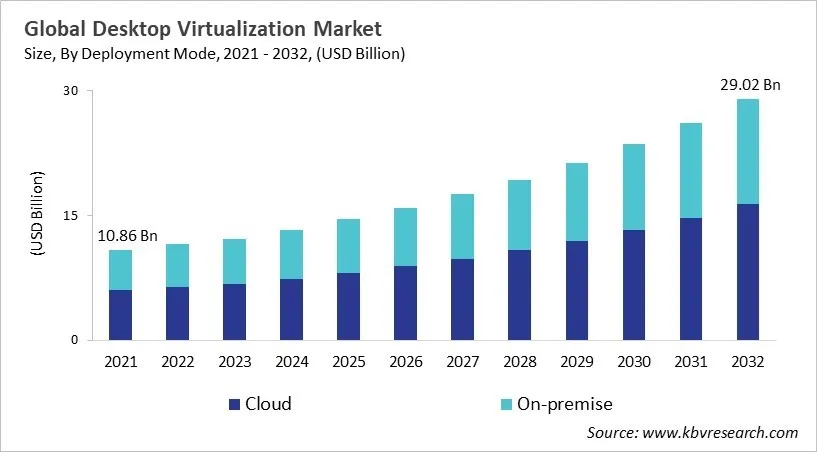
The Global Desktop Virtualization Market size is expected to reach $29.02 billion by 2032, rising at a market growth of 10.4% CAGR during the forecast period.
Desktop virtualization is a technology that separates the desktop environment from physical devices. It sends operating systems, applications, and user data from centralized data centers or cloud platforms. In addition, It grew from early mainframe computing and later server virtualization to more advanced solutions like Remote Desktop Services (RDS) and Virtual Desktop Infrastructure (VDI). Big companies like IBM, Microsoft, Citrix, and VMware made the space more commercial and advanced. Cloud-based services like Azure Virtual Desktop and Citrix Virtual Apps and Desktops made it possible to deploy systems that can grow and change as needed. Adoption first focused on big businesses and industries that are heavily regulated because of benefits like centralized management, lower costs, and better data security. The COVID-19 pandemic sped up the adoption of desktop virtualization by a lot because companies quickly set up remote work, making it an important tool for keeping businesses running and giving employees more freedom.
In the last few years, the market has moved strongly toward cloud-hosted and Desktop-as-a-Service (DaaS) models. These models make it easier to get started and support hybrid deployment strategies. Cloud-first adoption, deeper security integration, and the ability to use hybrid and BYOD work models are all important trends that are changing the market. Vendors are setting themselves apart more and more by making security a top priority in their designs, following zero-trust principles, having strong compliance capabilities, and being able to work with identity and access management platforms. Continuous product modernization, strategic partnerships, flexible licensing models, and support for hybrid clouds all affect how companies compete with each other. Because of this, desktop virtualization is now seen as an important part of modern digital workplaces that can help workers in any field change in a safe, scalable, and flexible way.
The major strategies followed by the market participants are Partnerships as the key developmental strategy to keep pace with the changing demands of end users. For instance, In February, 2025, Cisco Systems, Inc. announced the partnership with NVIDIA, a Computer Manufacturer Corporation, accelerating AI adoption in enterprise data centers. This partnership integrates Cisco's networking solutions with NVIDIA's Spectrum-X Ethernet platform, providing high-performance, low-latency, and energy-efficient networking tailored for AI workloads. The partnership seeks to simplify the management of enterprise and cloud provider networks by unifying architectural models between front-end and back-end systems. In March, 2025, Citrix Systems, Inc. teamed up with NVIDIA, a computer manufacturer corporation to deliver AI virtual workstations using NVIDIA RTX Virtual Workstation and Citrix DaaS. This collaboration enables enterprises to securely and cost-effectively develop, prototype, and deploy AI applications. It enhances security, accelerates AI development, and reduces costs by leveraging existing GPUs within Citrix environments.
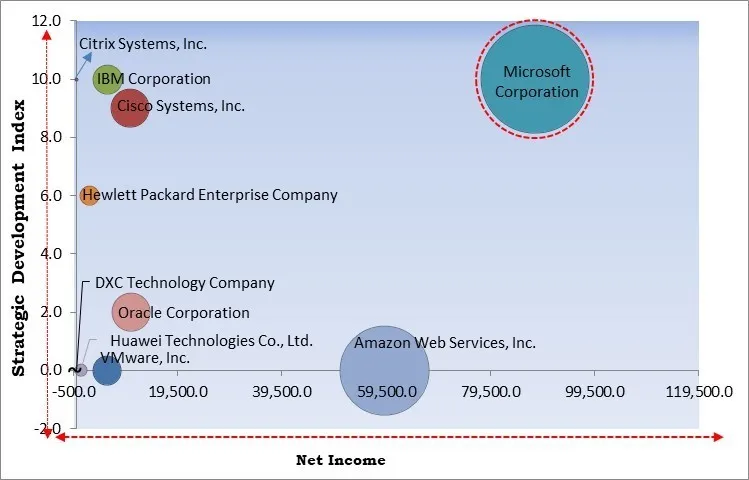
Based on the Analysis presented in the KBV Cardinal matrix; Microsoft Corporation is the forerunner in the Desktop Virtualization Market. In September, 2024, Microsoft Corporation announced the partnership with BlackRock, Global Infrastructure Partners, and MGX to establish the Global AI Infrastructure Investment Partnership. This initiative aims to invest in data centers and energy infrastructure to support the growing demands of artificial intelligence technologies. Companies such as Amazon Web Services, Inc., Oracle Corporation, and Cisco Systems, Inc. are some of the key innovators in Desktop Virtualization Market.
The COVID-19 pandemic sped up the use of desktop virtualization a lot because companies quickly moved to remote work to keep their businesses running. Virtual desktop infrastructure made it easier for a workforce spread out over a large area to access applications and data in a secure, scalable, and centrally managed way. Businesses saw how well it worked for provisioning, maintenance, and updates during long periods when offices were closed. Increased worries about cybersecurity made adoption even more likely, since virtualization lowered endpoint risks by keeping data in safe data centers or cloud environments. At the same time, more people using the cloud made desktop virtualization a more common business solution instead of just an extra technology. Thus, the COVID-19 pandemic had a Positive impact on the market.

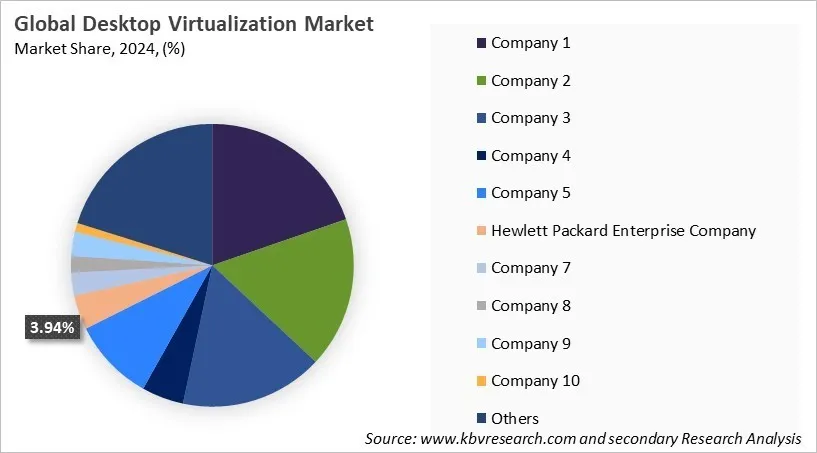
The leading players in the market are competing with diverse innovative offerings to remain competitive in the market. The above illustration shows the percentage of revenue shared by some of the leading companies in the market. The leading players of the market are adopting various strategies in order to cater demand coming from the different industries. The key developmental strategies in the market are Acquisitions, and Partnerships & Collaborations.
Free Valuable Insights: Desktop Virtualization Market size to reach USD 29.02 Billion by 2032
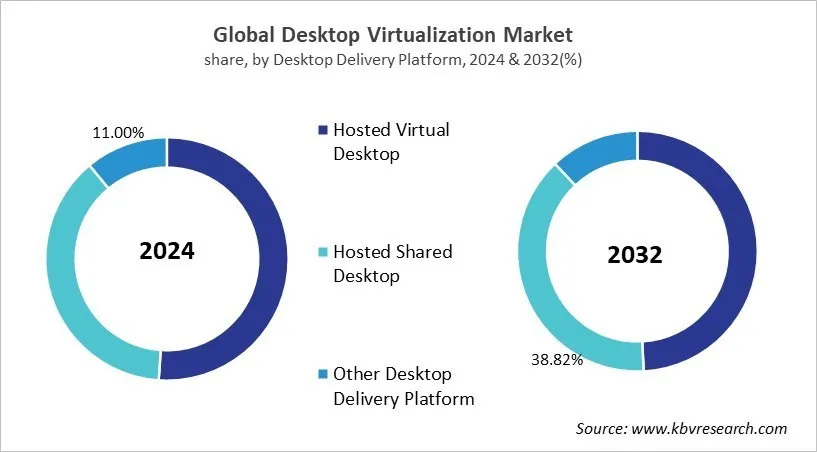
Based on Desktop Delivery Platform, the market is segmented into Hosted Virtual Desktop, Hosted Shared Desktop, and Other Desktop Delivery Platform. The Hosted Shared Desktop segment attained 38% revenue share in the market in 2024. The Hosted Shared Desktop (HSD) platform in the Desktop Virtualization Market provides multiple users access to a single virtual desktop environment hosted on centralized servers. This platform is optimized for scenarios where many users require access to a standardized set of applications and resources, enabling efficient utilization of computing resources.
Based on End-User Vertical, the market is segmented into IT & Telecommunications, Financial Services, Healthcare, Manufacturing, and Other End-User Vertical. The Financial Services segment attained 23% revenue share in the market in 2024. The Financial Services vertical in the Desktop Virtualization Market includes banking, insurance, investment, and other financial institutions. These organizations prioritize high levels of security, compliance, and data protection while delivering seamless services to clients. Virtual desktop solutions allow financial services companies to centralize sensitive data, monitor user activity, and enforce strict security policies, reducing the risk of data breaches or unauthorized access.
Region-wise, the Desktop Virtualization Market is analyzed across North America, Europe, Asia Pacific, and LAMEA. The North America segment recorded 37% revenue share in the market in 2024. In North America and Europe, advanced digital infrastructure, high cloud penetration, and strict rules in industries like BFSI, government, and healthcare are pushing the use of desktop virtualization. Large companies have been the first to adopt these technologies, using cloud-hosted and hybrid virtual desktop models to improve security, make sure they follow the rules, and support long-term hybrid work strategies. The strong presence of Microsoft, Citrix, and VMware as vendors, as well as the widespread use of platforms like Azure Virtual Desktop, have sped up the move toward scalable, cloud-first deployments. In these areas, desktop virtualization is becoming more and more of a strategic part of the modern digital workplace transformation. It focuses on zero-trust security, centralized control, and flexible workforces.
Desktop virtualization is becoming more popular in Asia Pacific and LAMEA. This is because cloud infrastructure is growing, digital transformation projects are underway, and there is a growing need for safe remote work solutions. Big companies and multinational corporations are still the main users, but cloud-based and Desktop-as-a-Service models are making it easier for small and medium-sized businesses to get started. In Asia Pacific, the rapid digitization of the economy and the movement of workers are driving adoption. In LAMEA, government-led modernization efforts and worries about cybersecurity are the main drivers. Desktop virtualization is becoming more important in both regions as a cheap and flexible way to support hybrid work, keep data safe, and workforces that are spread out across different locations.
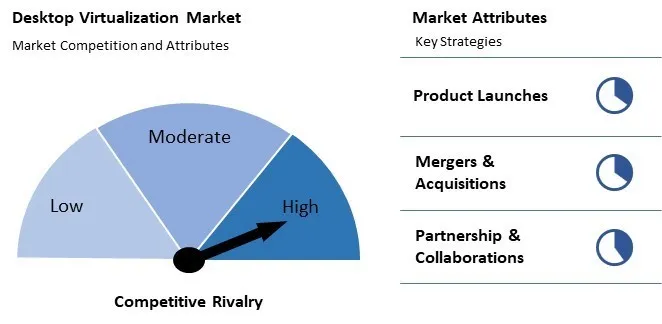
There is a lot of competition in the desktop virtualization market, and many providers are trying to stand out by offering better service, more features, and more scalability. To get a wide range of customers, players focus on improving user experience, security, and integration with cloud ecosystems. Strategic partnerships and the ability to change deployment models are two important ways to stay ahead of the competition. As performance and management tools get better all the time, competition gets tougher, which makes features and solutions change quickly across the market.
| Report Attribute | Details |
|---|---|
| Market size value in 2025 | USD 14.53 Billion |
| Market size forecast in 2032 | USD 29.02 Billion |
| Base Year | 2024 |
| Historical Period | 2021 to 2023 |
| Forecast Period | 2025 to 2032 |
| Revenue Growth Rate | CAGR of 10.4% from 2025 to 2032 |
| Number of Pages | 518 |
| Number of Tables | 364 |
| Report coverage | Market Trends, Revenue Estimation and Forecast, Segmentation Analysis, Regional and Country Breakdown, Competitive Landscape, Market Share Analysis, Porter’s 5 Forces Analysis, Company Profiling, Companies Strategic Developments, SWOT Analysis, Winning Imperatives |
| Segments covered | Deployment Mode, Desktop Delivery Platform, End-User Vertical, Region |
| Country scope |
|
| Companies Included | Citrix Systems, Inc. (Cloud Software Group, Inc.), Microsoft Corporation, VMware, Inc. (Broadcom Inc.), Cisco Systems, Inc., Amazon Web Services, Inc. (Amazon.com, Inc.), Hewlett Packard Enterprise Company, Huawei Technologies Co., Ltd. (Huawei Investment & Holding Co., Ltd.), Oracle Corporation, IBM Corporation, and DXC Technology Company |
By Deployment Mode
By Desktop Delivery Platform
By End-User Vertical
By Geography
The market size is projected to reach USD 22.64 billion by 2032.
The desktop virtualization market is projected to grow at a CAGR of 9.9% between 2025 and 2032.
Increasing product design complexity and need for virtual prototyping, driving strong CAE adoption across automotive electrification, aerospace innovation, and mobility technologies.
ANSYS, Inc., Altair Engineering Inc., Autodesk, Inc., Bentley Systems, Inc., Dassault Systemes SE, ESI Group (Keysight Technologies, Inc.), Hexagon AB, Siemens AG, PTC, Inc. and The MathWorks, Inc.
The On-premise segment registered maximum revenue in the Global desktop virtualization Market by Deployment Model in 2024, growing at a CAGR of 9.6 % during the forecast period.
The North America region dominated the Global desktop virtualization Market by Region in 2024, and would continue to be a dominant market till 2032; thereby, achieving a market value of $7.12 billion by 2032.
Our team of dedicated experts can provide you with attractive expansion opportunities for your business.












 Unique Offerings