“Global Digital Assurance Market to reach a market value of USD 11.92 Billion by 2032 growing at a CAGR of 12.3%”
The Global Digital Assurance Market size is expected to reach USD 11.92 billion by 2032, rising at a market growth of 12.3% CAGR during the forecast period.
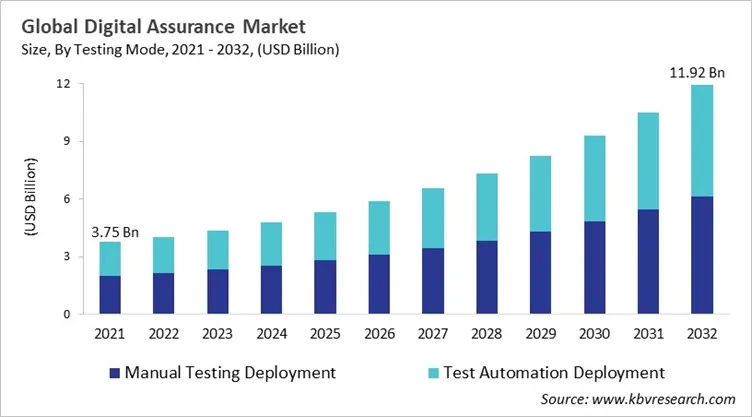
Digital assurance has positioned itself as strategic capability essential for governing modern digital ecosystems, developing from traditional, end-of-cycle IT testing. With the accelerated adoption of IoT, analytics, cloud, AI and mobile across enterprises, risk surface and complexity of digital systems have expanded, thereby surging the demand for security-by-design, continuous monitoring, user-experience validation, and performance reliability. Enterprises and governments now consider assurance as a foundation of regulatory compliance, and digital resilience, transitioning from reactive testing to integrated, lifecycle-wide quality engineering. This shift is driven by trends including DevOps-embedded continuous assurance, AI-driven automation, and stringent regulatory and security needs, resulting in positioning digital assurance as a driver of operational stability, and digital transformation.
Key market players are adopting strategies focused on domain-specialized frameworks, platform-led assurance, and the alignment of assurance with digital value chains. AI-driven assurance platforms surge testing, enhance defect prediction, and embed quality early in delivery, whereas domain-focused models cater the operational and regulatory complexities of industries such as healthcare, finance and the public-sector. The market’s competitive differentiation largely depends on the integration with CI/CD pipelines, the ability to assure complex multi-cloud and microservices environments, and automation maturity. Considering all this, the digital assurance market is becoming more competitive and sophisticated, with providers that combine automation, consulting, scalable delivery, and domain expertise positioning themselves as leaders in enabling high-quality, secure, and resilient digital services.
The COVID-19 pandemic sped up the digital assurance market a lot because companies quickly moved to digital transformation and remote work, which made them more dependent on apps, communication platforms, and cloud-based services. These changes increased cybersecurity risks and digital footprints, which led to a high demand for compliance validation, risk assessment, and security testing. Digital use grew quickly in industries like BFSI, healthcare, retail, and education. To make sure customers had a smooth experience, these industries relied on constant testing, automation, and performance monitoring. The rise in online transactions and remote access made the need for reliability, resilience, and data protection even clearer. Also, the widespread use of cloud computing and agile development methods gave digital assurance vendors new ways to help with faster release cycles and keep performance up across distributed digital environments. This helped the market grow during the pandemic. Thus, the COVID-19 pandemic had a positive impact on the market.

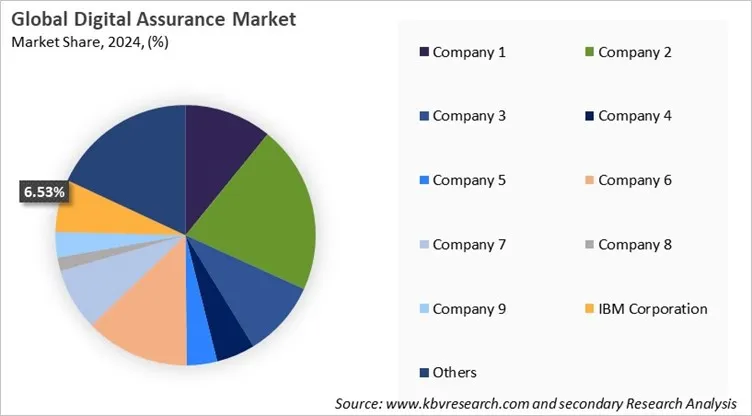
The leading players in the market are competing with diverse innovative offerings to remain competitive in the market. The above illustration shows the percentage of revenue shared by some of the leading companies in the market. The leading players of the market are adopting various strategies to cater demand coming from the different industries. The key developmental strategies in the market are Acquisitions, and Partnerships & Collaborations.
Based on testing mode, the digital assurance market is characterized as manual testing deployment and test automation deployment. The test automation deployment segment attained 47% revenue share in the digital assurance market in 2024. The test automation deployment segment serves as a key enabler of efficiency and scalability within the digital assurance landscape. By leveraging automated tools and frameworks, this segment helps organizations accelerate testing cycles, enhance accuracy, and support continuous integration and delivery practices.
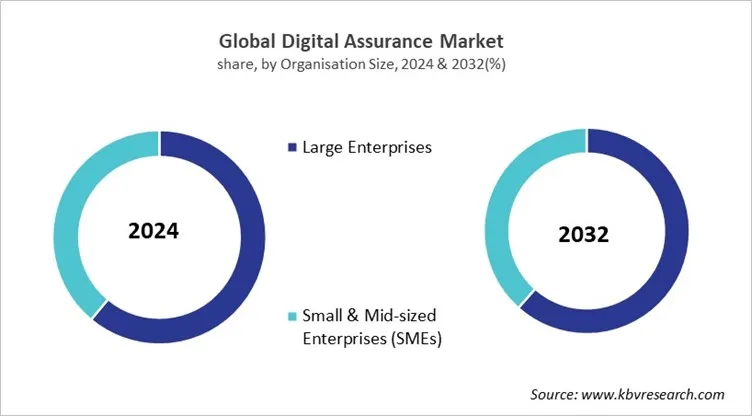
On the basis of organisation size, the digital assurance market is classified into large enterprises and small & mid-sized enterprises (SMEs). The small & mid-sized enterprises (SMEs) segment recorded 39% revenue share in the digital assurance market in 2024. The small & mid-sized enterprises (SMEs) segment contributes meaningfully to the digital assurance market as these businesses increasingly adopt digital tools and platforms to improve competitiveness and operational agility. SMEs seek scalable and cost-effective assurance solutions that help them validate application performance, strengthen cybersecurity, and support smooth integration of new technologies.
Free Valuable Insights: Digital Assurance Market size to reach USD 11.92 Billion by 2032
Region-wise, the digital assurance market is analyzed across North America, Europe, Asia Pacific, and LAMEA. The digital assurance market is estimated to experience significant expansion in the North America and Europe region. The growth is supported by well-established digital ecosystems, rapid adoption of AI, and strict regulatory environments. North America, especially the US, represents high demand backed by large-scale digital transformation programs across healthcare, banking, public-sector agencies, and retail sectors. Regulatory concerns around cybersecurity, operational resilience, and data protection surge investments in continuous assurance, AI-driven automation, and security testing. Additionally, Europe digital assurance market is witnessing growth driven by the Digital Operational Resilience Act (DORA), GDPR, and national e-government modernization initiatives. European organizations emphasize compliance validation, risk-based assurance, and robust quality engineering across IoT, cloud, and multi-country digital platforms. Both North America, as well as Europe represent high adoption of domain-specific frameworks, DevOps-embedded assurance, and advanced adoption platforms, showcasing their emphasis on security, governance, and delivery reliability.
In Asia Pacific and LAMEA region, the digital assurance market is projected to gather prominent market share during the forecast period. The market is shaped by surged cloud adoption, and governments as well as enterprises scaling in digital infrastructure. Asia Pacific is witnessing accelerated digital-government demand because of rapid 5G rollout, expanding fintech ecosystems, and national digital-government mission in India, China, Australia, and Singapore. Enterprises in the region largely rely on automated, AI-enabled assurance with aim of supporting high-volume digital services, and distributed architectures. Furthermore, LAMEA region is showcasing growth opportunities as digital assurance is gaining traction through modernization of banking, telecom and public-services. The demand for scalable, cost-effective assurance solutions is rising with increasing investment in smart-city initiatives, cloud-platforms, and cybersecurity strengthening. As a conclusion, both Asia Pacific and LAMEA region are offering growth opportunities supported by the requirement to ensure secure, resilient, and high-quality digital services.
| Report Attribute | Details |
|---|---|
| Market size value in 2025 | USD 5.29 Billion |
| Market size forecast in 2032 | USD 11.92 Billion |
| Base Year | 2024 |
| Historical Period | 2021 to 2023 |
| Forecast Period | 2025 to 2032 |
| Revenue Growth Rate | CAGR of 12.3% from 2025 to 2032 |
| Number of Pages | 660 |
| Number of Tables | 562 |
| Report coverage | Market Trends, Revenue Estimation and Forecast, Segmentation Analysis, Regional and Country Breakdown, Market Share Analysis, Porter’s 5 Forces Analysis, Company Profiling, Companies Strategic Developments, SWOT Analysis, Winning Imperatives |
| Segments covered | Testing Mode, Organisation Size, Testing Type, End-user Vertical, Service Model, Region |
| Country scope |
|
| Companies Included | Capgemini SE, Accenture PLC, Cognizant Technology Solutions Corporation, Wipro Limited, Atos SE, Tata Consultancy Services Ltd., Infosys Limited, Cigniti Technologies Limited (Coforge Limited), DXC Technology Company, IBM Corporation |
By Testing Mode
By Organisation Size
By Testing Type
By End-user Vertical
By Service Model
By Geography
The market size is projected to reach USD 11.92 Billion by 2032.
The digital assurance market is projected to grow at a CAGR of 12.3% between 2025 and 2032.
Rising enterprise adoption of complex digital ecosystems, coupled with the rapid growth of cloud-native development and DevOps practices, is driving increased operational complexity and transformation.
Capgemini SE, Accenture PLC, Cognizant Technology Solutions Corporation, Wipro Limited, Atos SE, Tata Consultancy Services Ltd., Infosys Limited, Cigniti Technologies Limited (Coforge Limited), DXC Technology Company, IBM Corporation
The Banking, Financial Services & Insurance (BFSI) segment led the Global Digital Assurance Market by End-user Vertical in 2024; thereby, achieving a market value of $3.01 billion by 2032.
The North America region dominated the Global Digital Assurance Market by Region in 2024, and would continue to be a dominant market till 2032; thereby, achieving a market value of $4.22 billion by 2032.
Our team of dedicated experts can provide you with attractive expansion opportunities for your business.







 Unique Offerings