“Global Digital Inspection Market to reach a market value of USD 36.15 Billion by 2032 growing at a CAGR of 6.3%”
The Global Digital Inspection Market size is expected to reach $36.15 billion by 2032, rising at a market growth of 6.3% CAGR during the forecast period.
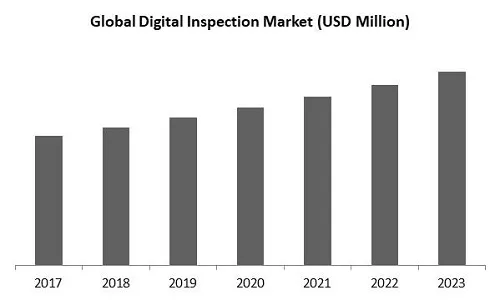
The Global Digital Inspection Market has changed from manual, labor-intensive inspection methods to advanced, automated, and data-driven systems that meet the needs of modern quality assurance, safety, and compliance. Industry 4.0 and government-backed digital transformation programs have made machine vision, automated imaging, sensor-based inspection, and nondestructive evaluation technologies more popular than traditional visual checks. NDE 4.0 is an example of a framework that shows how AI, cloud computing, and digital twins can be used together in inspection workflows. This makes inspections more accurate, gives real-time insights, and makes them fit better with production and asset management systems.
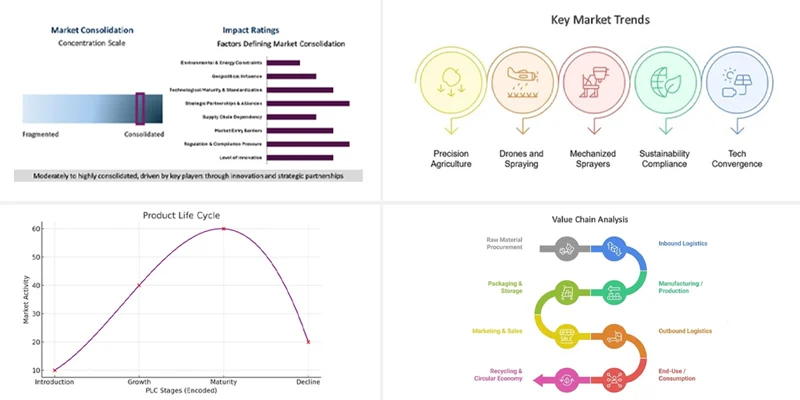
The use of AI and machine learning for automated defect detection, IIoT-enabled connected inspection environments, and remote inspection technologies like drones, robotics, and AR-assisted tools are all having an effect on the market right now. These new ideas help models of continuous and predictive inspection that make operations more efficient and lower risk. There are established industrial technology providers, specialized solution firms, and new innovators all competing with each other. Technology integration, scalable platforms, and strong service capabilities set them apart. Digital inspection has become an important part of smart, data-driven industrial operations as businesses put more emphasis on quality, safety, and resilience.
In the beginning stages of the COVID-19 pandemic, the digital inspection market slowed down for a short time because of widespread lockdowns and operational restrictions that made it hard for manufacturing, construction, and industrial activities to continue. Supply chain problems made it even harder to get inspection hardware, sensors, and imaging systems, which caused deployments to be delayed and project timelines to be longer. Increased economic uncertainty made businesses put off capital investments, especially small and medium-sized businesses that put business continuity and employee safety first. Also, restrictions on travel and the workforce made it harder to do on-site inspections, integrate systems, and provide training services. All of these things together slowed down the market during the pandemic and made it harder for people to adopt new technologies in the short term. Thus, the COVID-19 pandemic had a negative impact on the market.

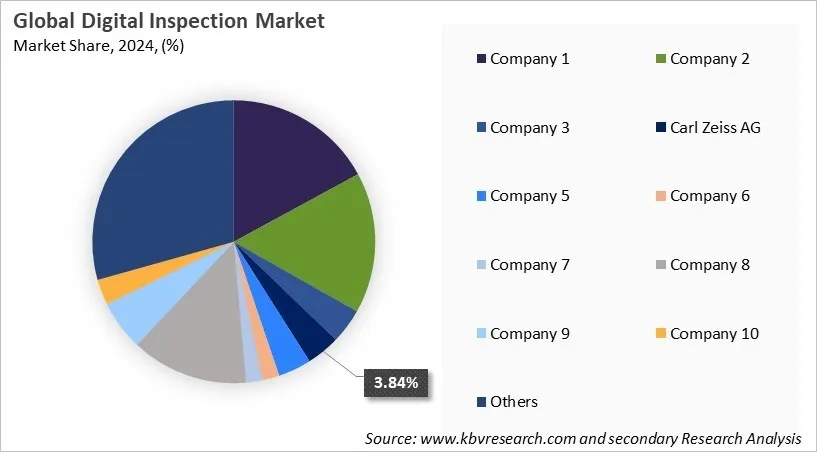
The leading players in the market are competing with diverse innovative offerings to remain competitive in the market. The above illustration shows the percentage of revenue shared by some of the leading companies in the market. The leading players of the market are adopting various strategies in order to cater demand coming from the different industries. The key developmental strategies in the market are Acquisitions, and Partnerships & Collaborations.
Based on Dimension, the market is segmented into 2D, and 3D. The 3D segment acquired 43% revenue share in the market in 2024. The 3D segment of the Digital Inspection Market is characterized by its ability to capture depth, volume, and geometric complexity with a high level of precision. This segment is widely utilized in applications that require detailed spatial analysis, such as dimensional validation, structural assessment, and complex surface inspection.
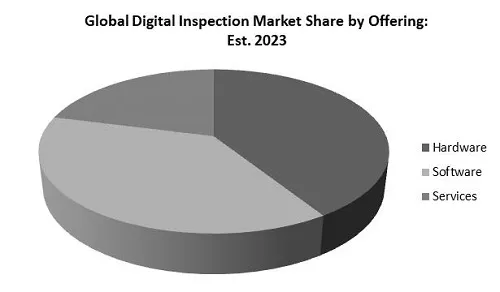
Based on Technology, the market is segmented into Machine Vision, Metrology, and NDT (Non-Destructive Testing). The Metrology segment attained 33% revenue share in the market in 2024. The Metrology segment in the Digital Inspection Market focuses on precise measurement and dimensional analysis to ensure products meet strict design and engineering specifications. This technology is widely applied in industries that require high accuracy, such as automotive, aerospace, electronics, and precision manufacturing.
Free Valuable Insights: Digital Inspection Market size to reach USD 36.15 Billion by 2032
Region-wise, the Digital Inspection Market is analyzed across North America, Europe, Asia Pacific, and LAMEA. The North America segment recorded 35% revenue share in the market in 2024. North America and Europe are mature and technologically advanced markets for digital inspection. This is because they were early adopters of Industry 4.0, have strong regulatory frameworks, and place a high value on quality, safety, and compliance. Machine vision, automated NDE systems, AI-driven defect detection, and cloud-based inspection platforms are used a lot in the manufacturing, aerospace, automotive, energy, and infrastructure sectors in these areas. Government-backed programs set up standards bodies, and close cooperation between tech companies and industrial companies speeds up innovation and adoption. Because of this, digital inspection is becoming more and more a part of smart manufacturing, predictive maintenance, and asset integrity management plans in North America and Europe.
The digital inspection market is growing quickly in Asia Pacific and LAMEA. This is because of rapid industrialization, more manufacturing capacity, and more money going into infrastructure and energy projects. China, Japan, South Korea, and India are leading the way in Asia Pacific in the use of automated inspection and IIoT-enabled systems to improve quality and production efficiency. In LAMEA, the energy, utilities, transportation, and construction sectors are driving adoption, with more and more use of drones, robots, and remote inspection technologies. Both Asia Pacific and LAMEA have a lot of room for long-term growth, even though they are still developing compared to more developed areas. This is because digital transformation and regulatory oversight are getting stronger.
| Report Attribute | Details |
|---|---|
| Market size value in 2025 | USD 23.60 Billion |
| Market size forecast in 2032 | USD 36.15 Billion |
| Base Year | 2024 |
| Historical Period | 2021 to 2023 |
| Forecast Period | 2025 to 2032 |
| Revenue Growth Rate | CAGR of 6.3% from 2025 to 2032 |
| Number of Pages | 568 |
| Number of Tables | 465 |
| Report coverage | Market Trends, Revenue Estimation and Forecast, Segmentation Analysis, Regional and Country Breakdown, Market Share Analysis, Porter’s 5 Forces Analysis, Company Profiling, Companies Strategic Developments, SWOT Analysis, Winning Imperatives |
| Segments covered | Dimension, Technology, Component, Vertical, Region |
| Country scope |
|
| Companies Included | General Electric Company, Cognex Corporation, Basler AG, Carl Zeiss AG, Omron Corporation, Intertek Group PLC, Bureau Veritas S.A., Hexagon AB, Olympus Corporation, and Emerson Electric Co. |
By Dimension
By Technology
By Component
By Vertical
By Geography
The market size is projected to reach USD 36.15 Billion by 2032.
The digital inspection market is projected to grow at a CAGR of 6.3% between 2025 and 2032.
Rising adoption of Industry 4.0 and smart manufacturing, alongside stricter quality, safety, and regulatory compliance requirements, is driving market growth.
General Electric Company, Cognex Corporation, Basler AG, Carl Zeiss AG, Omron Corporation, Intertek Group PLC, Bureau Veritas S.A., Hexagon AB, Olympus Corporation, and Emerson Electric Co.
The 2D segment captured the maximum revenue in the Global Digital Inspection Market by Dimension in 2024, thereby, achieving a market value of $20.0 billion by 2032.
The North America region dominated the Global Digital Inspection Market by Region in 2024, and would continue to be a dominant market till 2032; thereby, achieving a market value of $11.8 billion by 2032.
Our team of dedicated experts can provide you with attractive expansion opportunities for your business.












 Unique Offerings