“Global Emission Monitoring Systems Market to reach a market value of USD 7.87 Billion by 2032 growing at a CAGR of 10%”
The Global Emission Monitoring Systems Market size is expected to reach $7.87 billion by 2032, rising at a market growth of 10.0% CAGR during the forecast period.
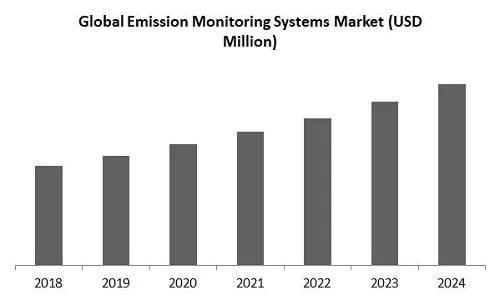
Emission monitoring systems are necessary for keeping track of and reporting pollutants from stationary and industrial sources. This is important for following the rules, protecting air quality, and supporting sustainable operations. Environmental laws like the U.S. Clean Air Act and rules enforced by agencies like the EPA have pushed these systems to change from being manual, periodic reporting tools to highly automated, always-on monitoring networks. Continuous Emission Monitoring Systems (CEMS) and frameworks for monitoring ambient air now provide emissions data that is almost real-time, thanks to strict standards for quality assurance and reporting. Regulatory pressures like these are growing around the world, especially in Europe and Asia. This means that regulated industries must monitor their emissions and cannot negotiate about it.
The emission monitoring systems market has changed because of stricter rules and new technology from major OEMs like Siemens Energy and ABB. The industry is moving away from CEMS that rely heavily on hardware and toward digital and Predictive Emission Monitoring Systems (PEMS). These systems use advanced algorithms and operational data to estimate emissions in a cost-effective way. Cloud connectivity, analytics, and automation are all part of modern solutions. This makes it possible to manage emissions proactively, optimize operations, and make sustainability reporting easier. Compliance with rules, technological differences, and excellent service drive competition in the market. This makes emission monitoring systems critical infrastructure for both compliance and making strategic environmental and operational decisions.
The COVID-19 pandemic had a huge impact on the healthcare industry, causing a big drop in non-urgent imaging procedures as hospitals focused on treating COVID-19 patients and saw fewer patients overall. This drop in imaging volume made imaging informatics platforms less useful. Financial pressures also delayed IT investments and pushed back the planned deployment of PACS improvements and AI-based tools. Operational problems, such as not having enough workers and having to move staff around, made it even harder to integrate and implement the system on time. Also, problems with the global supply chain caused delays in imaging hardware and IT parts, which made installations take longer and slowed down market activity. As a result, the pandemic had a very bad effect on the imaging informatics market. Thus, the COVID-19 pandemic had a negative impact on the market.

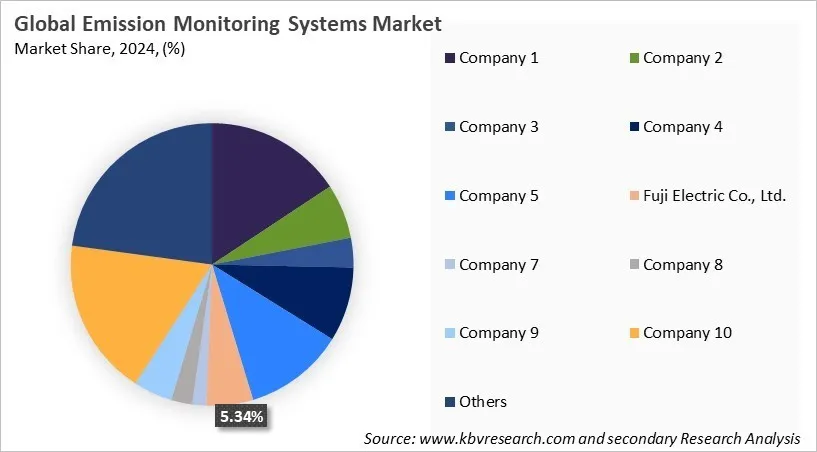
The leading players in the market are competing with diverse innovative offerings to remain competitive in the market. The above illustration shows the percentage of revenue shared by some of the leading companies in the market. The leading players of the market are adopting various strategies in order to cater demand coming from the different industries. The key developmental strategies in the market are Acquisitions, and Partnerships & Collaborations.
Based on Type, the market is segmented into Continuous Emission Monitoring System (CEMS), and Predictive Emission Monitoring System (PEMS). The Predictive Emission Monitoring System (PEMS) segment acquired 25% revenue share in the market in 2024. The Predictive Emission Monitoring System (PEMS) segment has emerged as an innovative approach to emission monitoring, leveraging advanced algorithms and modeling techniques to estimate emissions based on operational data. Unlike continuous monitoring, PEMS predicts emission levels by analyzing variables such as fuel consumption, temperature, pressure, and other process parameters, offering a cost-effective and flexible solution for industries with complex processes.
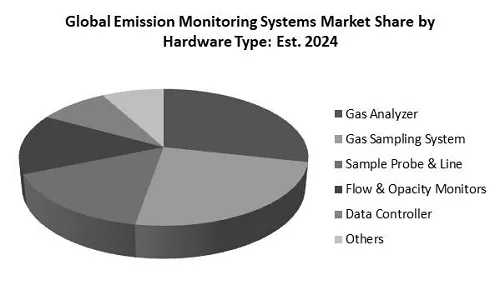
Based on Component, the market is segmented into Hardware, Software, and Services. The Software segment attained 27% revenue share in the market in 2024. The Software segment in the emission monitoring systems market focuses on the platforms and tools required to process, analyze, and report emission data efficiently. Software solutions facilitate data management, trend analysis, predictive modeling, and regulatory reporting, enabling organizations to transform raw data into actionable insights. Advanced software tools often incorporate cloud connectivity, artificial intelligence, and machine learning to enhance data accuracy and provide predictive capabilities, supporting proactive environmental management.
Free Valuable Insights: Emission Monitoring Systems Market size to reach USD 7.87 Billion by 2032
Region-wise, the Emission Monitoring Systems Market is analyzed across North America, Europe, Asia Pacific, and LAMEA. The North America segment recorded 34% revenue share in the market in 2024. Emission monitoring systems are well-known in North America and Europe because they have strict and long-lasting environmental rules. The Clean Air Act and New Source Performance Standards (NSPS) are two laws in the United States that say the Environmental Protection Agency (EPA) must keep an eye on emissions all the time. These rules say that CEMS or approved predictive monitoring systems must be very accurate and come with strict requirements for quality assurance, verification, and reporting. Europe has similar rules, like the Industrial Emissions Directive and the EU Emissions Trading System, that put a lot of emphasis on verified, real-time emissions data and openness. Regulatory enforcement that is consistent, along with ambitious climate goals and corporate sustainability efforts, continues to drive widespread use of advanced, digitally integrated CEMS and PEMS solutions in industries like power generation, oil and gas, and other heavy industrial sectors.
Asia Pacific and LAMEA are quickly becoming high-growth markets for emission monitoring systems. This is because industrialization is speeding up and environmental rules are getting stricter. To fight air pollution and meet climate goals, governments in the Asia Pacific region are putting more emphasis on emissions monitoring. This is increasing demand for both continuous and predictive monitoring solutions. In the LAMEA region, more activity in industries like energy, petrochemicals, and mining, along with stricter government oversight, is pushing the use of emission monitoring technologies that are both affordable and scalable. As policies to control pollution change and sustainability reporting becomes more important, the need for modern and reliable emissions monitoring systems is growing steadily in both areas.
| Report Attribute | Details |
|---|---|
| Market size value in 2025 | USD 4.04 Billion |
| Market size forecast in 2032 | USD 7.87 Billion |
| Base Year | 2024 |
| Historical Period | 2021 to 2023 |
| Forecast Period | 2025 to 2032 |
| Revenue Growth Rate | CAGR of 10.0% from 2025 to 2032 |
| Number of Pages | 576 |
| Number of Tables | 471 |
| Report coverage | Market Trends, Revenue Estimation and Forecast, Segmentation Analysis, Regional and Country Breakdown, Market Share Analysis, Porter’s 5 Forces Analysis, Company Profiling, Companies Strategic Developments, SWOT Analysis, Winning Imperatives |
| Segments covered | Type, Component, End-Use, Region |
| Country scope |
|
| Companies Included | ABB Ltd., Ametek, Inc., Babcock & Wilcox Enterprises, Inc., Baker Hughes Company, Emerson Electric Co., Fuji Electric Co. Ltd., Intertek Group PLC, Parker Hannifin Corporation, Rockwell Automation, Inc., and Siemens AG |
By Type
By Component
By End Use
By Geography
The market size is projected to reach USD 7.87 Billion by 2032.
The emission monitoring systems market is projected to grow at a CAGR of 10% between 2025 and 2032.
Stringent environmental regulations and government policies reinforcing growing corporate commitment to sustainability and ESG practices.
ABB Ltd., Ametek, Inc., Babcock & Wilcox Enterprises, Inc., Baker Hughes Company, Emerson Electric Co., Fuji Electric Co. Ltd., Intertek Group PLC, Parker Hannifin Corporation, Rockwell Automation, Inc., and Siemens AG
The Hardware segment led the maximum revenue in the Global Emission Monitoring Systems Market by Component in 2024, thereby, achieving a market value of $4.1 billion by 2032.
The North America region dominated the Global Emission Monitoring Systems Market by Region in 2024, and would continue to be a dominant market till 2032; thereby, achieving a market value of $2.5 billion by 2032.
Our team of dedicated experts can provide you with attractive expansion opportunities for your business.








 Unique Offerings