The Europe Piezoelectric Materials Market is expected to reach $424.70 million by 2031 and would witness market growth of 4.1% CAGR during the forecast period (2025-2032).
The Germany market dominated the Europe Piezoelectric Materials Market by Country in 2024, and would continue to be a dominant market till 2032; thereby, achieving a market value of $108.1 million by 2032. The UK market is exhibiting a CAGR of 2.9% during (2025 - 2032). Additionally, The France market would experience a CAGR of 5% during (2025 - 2032). The Germany and UK led the Europe Piezoelectric Materials Market by Country with a market share of 26.6% and 14.9% in 2024. The Italy market is expected to witness a CAGR of 5.4% during throughout the forecast period.
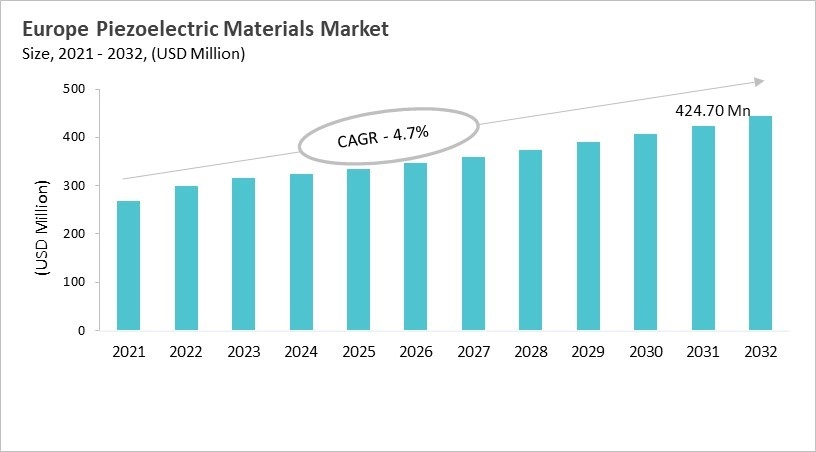
The European market for piezoelectric materials has grown because of a strong base of public research facilities, advanced manufacturing skills, and a lot of knowledge about functional ceramics and electronic parts. Historically supported by government initiatives and EU research programs, Europe has helped turn laboratory-scale piezoelectric phenomena into materials that can be used in sensors, actuators, and precision instruments. CeramTec GmbH and PI Ceramic GmbH are two of the most important OEMs that have helped make high-purity ceramic processing commercially viable. This has made it possible for industrial automation, medical devices, and automotive systems to work reliably while meeting strict European quality and regulatory standards. As the market has grown, it has been in line with regional goals for digitalization, energy efficiency, and sustainable technologies. This includes the creation of lead-free and multifunctional piezoelectric materials.
Today, Europe's ecosystem for piezoelectric materials is marked by specialization in technology, following the rules, and strong cooperation between OEMs and public research institutions. Companies are offering high-precision, application-specific solutions that are in line with market trends in smart manufacturing, robotics, medical technology, and structural health monitoring. Innovation in lead-free ceramics and circular manufacturing practices is driven by the need to be environmentally friendly and follow EU rules. Competition in the area is fairly strong, with companies focusing on performance, reliability, and customized solutions. Smaller niche players, on the other hand, focus on applications that need extreme precision. Overall, Europe's market shows that it is a mature, technology-driven place that is based on research excellence, advanced manufacturing, and a dedication to environmentally responsible innovation.
Based on End-use, the market is segmented into Automotive, Healthcare, Information & Telecom, Consumer Goods and Other End-use. With a compound annual growth rate (CAGR) of 1.5% over the projection period, the Automotive Market, dominate the Germany Piezoelectric Materials Market by End-use in 2024 and would be a prominent market until 2032. The Consumer Goods market is expected to witness a CAGR of 4.1% during (2025 - 2032).
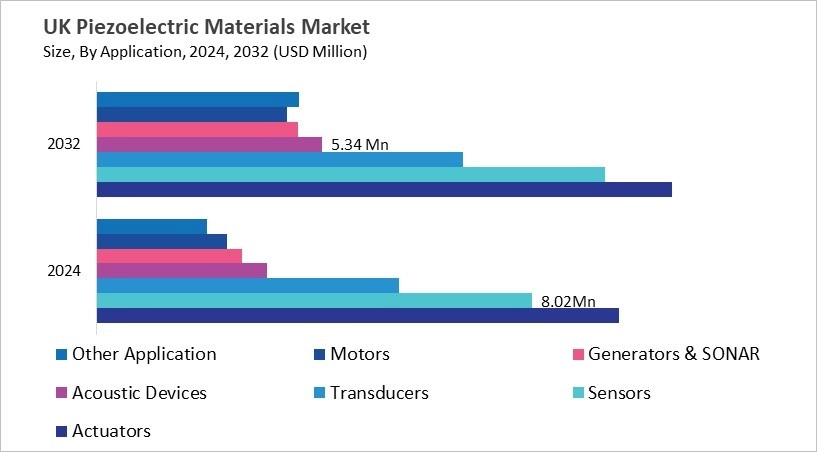
Based on Application, the market is segmented into Actuators, Sensors, Transducers, Acoustic Devices, Generators & SONAR, Motors and Other Application. Among various UK Piezoelectric Materials Market by Application; The Actuators market achieved a market size of USD $13.9 Million in 2024 and is expected to grow at a CAGR of 1.3 % during the forecast period. The Generators & SONAR market is predicted to experience a CAGR of 4.2% throughout the forecast period from (2025 - 2032).
Free Valuable Insights: The Worldwide Piezoelectric Materials Market is projected to reach USD 2.01 billion by 2032, at a CAGR of 4.4%
Germany's piezoelectric materials market is a major force behind Europe's advanced manufacturing and precision engineering sectors. This is because there is a lot of demand for high-precision parts and strict quality standards in the automotive, automation, and electromechanical industries. Physik Instrument (PI) and PI Ceramic are two of the biggest companies in the U.S. that make piezoelectric actuators, transducers, and lead-free ceramics for a wide range of uses, from ultra-precision positioning and nanopositioning to industrial sensors, medical devices, and robotics. Trends like combining with MEMS technologies, making sensors smaller, and more industrial automation and robotics are changing the market. German OEMs compete with global suppliers like TDK Electronics, which focus on high-precision, custom solutions. In the future, growth will come from materials that are energy-efficient and long-lasting, as well as investments in research and development and collaborations across Europe that support new uses for renewable energy, micro-robotics, and smart manufacturing.

By End-use
By Application
By Material Type
By Country
Our team of dedicated experts can provide you with attractive expansion opportunities for your business.



 Unique Offerings