The sample copy of this report is available for access.
“Global Industrial Control Systems Security Market to reach a market value of USD 38.03 Billion by 2033 growing at a CAGR of 6.8%”
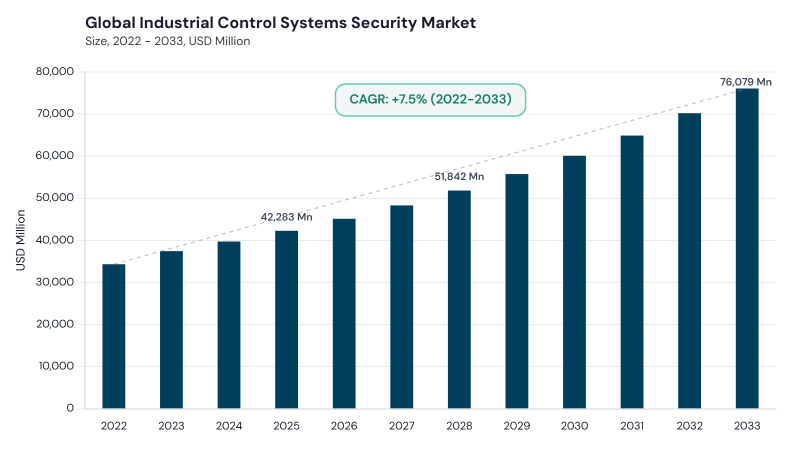
The Global Industrial Control Systems Security Market size is expected to reach USD 38.03 Billion by 2033, rising at a market growth of 7.7% CAGR during the forecast period.
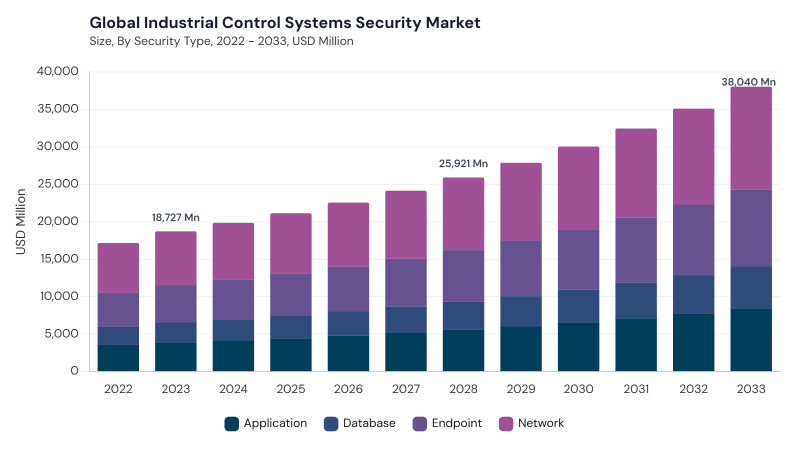
The increasing frequency of cyberattacks targeting critical infrastructure is accelerating demand for industrial cybersecurity solutions across manufacturing, energy, transportation, and utility sectors. The growing convergence of IT and operational technology (OT), along with rising industrial automation adoption, is further driving investments in advanced ICS security platforms.
The Global Industrial Control Systems Security Market has evolved significantly with the expansion of connected industrial environments and digital transformation initiatives across critical industries. Earlier industrial systems were designed primarily for operational efficiency with limited cybersecurity capabilities. However, the increasing integration of industrial control systems with enterprise IT networks has heightened cybersecurity risks, driving demand for specialized security solutions.
Organizations across manufacturing, energy & utilities, transportation, and automotive industries are increasingly adopting advanced security frameworks to protect operational continuity and critical infrastructure. The market is witnessing strong adoption of AI-enabled threat detection, zero-trust architectures, cloud-integrated monitoring, and real-time incident response solutions to strengthen industrial cybersecurity resilience.
The major strategies followed by the market participants are Partnerships, Collaborations, and Product Launches as the key developmental strategies to strengthen industrial cybersecurity capabilities and expand operational technology security ecosystems. For instance, in February 2025, Fortinet expanded its OT security portfolio with enhanced AI-powered industrial threat detection capabilities for critical infrastructure protection. Additionally, in May 2024, Schneider Electric strengthened its partnership ecosystem to improve OT cybersecurity interoperability and cloud-based industrial monitoring solutions across industrial environments.
The COVID-19 pandemic negatively impacted the Industrial Control Systems Security Market due to disruptions in industrial operations, delayed infrastructure projects, and reduced capital expenditure across several industries. Lockdowns and workforce limitations restricted on-site maintenance and deployment activities, delaying implementation of cybersecurity solutions within industrial environments. Supply chain disruptions also affected the procurement of critical security hardware and industrial networking equipment.
However, the pandemic accelerated digital transformation and remote monitoring initiatives across industrial sectors, increasing the need for secure remote access, cloud-based industrial monitoring, and advanced OT cybersecurity frameworks. Organizations prioritized cybersecurity resilience to address growing cyber threats targeting remote industrial operations. Thus, while the pandemic initially slowed market growth, it also reinforced the long-term importance of industrial cybersecurity investments.
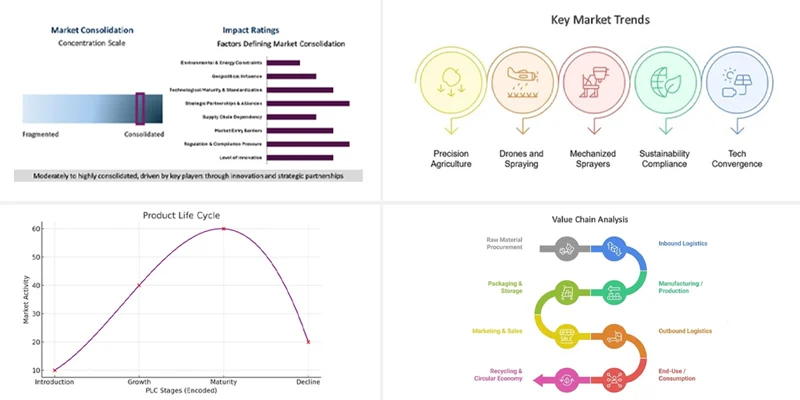

The Industrial Control Systems Security Market demonstrates a moderately consolidated competitive structure with several global cybersecurity and industrial automation companies accounting for a significant portion of total market revenue. Siemens AG emerged as one of the leading players in the market, accounting for approximately 11.8% market share in 2025, supported by its extensive industrial automation portfolio, integrated cybersecurity solutions, and strong presence across manufacturing and critical infrastructure industries. Companies such as Honeywell International Inc., Schneider Electric SE, ABB Ltd., Fortinet, Inc., and Palo Alto Networks, Inc. also maintain strong market positions through continuous investments in AI-enabled threat intelligence, OT security platforms, and industrial network protection solutions.
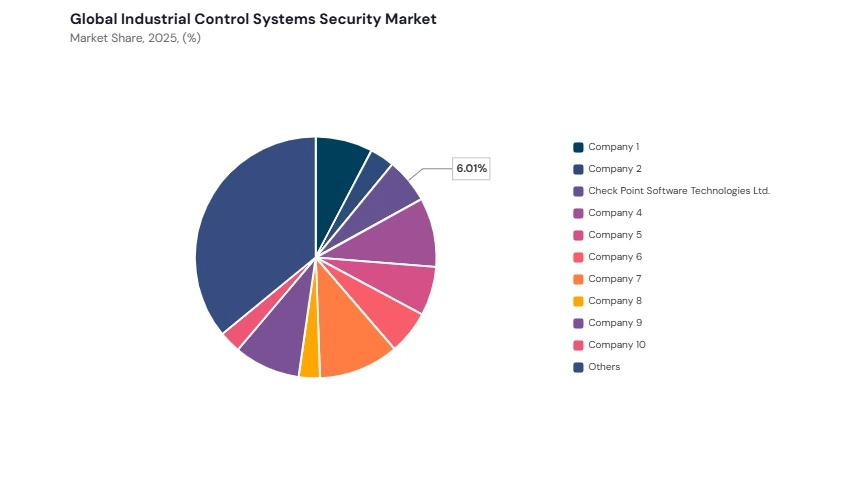
Market participants are increasingly focusing on strengthening interoperability between IT and OT environments, expanding cloud-based industrial monitoring capabilities, and enhancing real-time threat detection technologies to improve operational resilience. Strategic collaborations, acquisitions, and expansion of managed security services are further intensifying competition across the market. In addition, mid-tier and niche cybersecurity vendors are gaining traction by offering specialized solutions for industrial protocol security, anomaly detection, vulnerability management, and regulatory compliance support. The competitive landscape is expected to evolve further with increasing adoption of Industry 4.0 technologies, connected industrial systems, and AI-driven cybersecurity frameworks across critical infrastructure sectors.
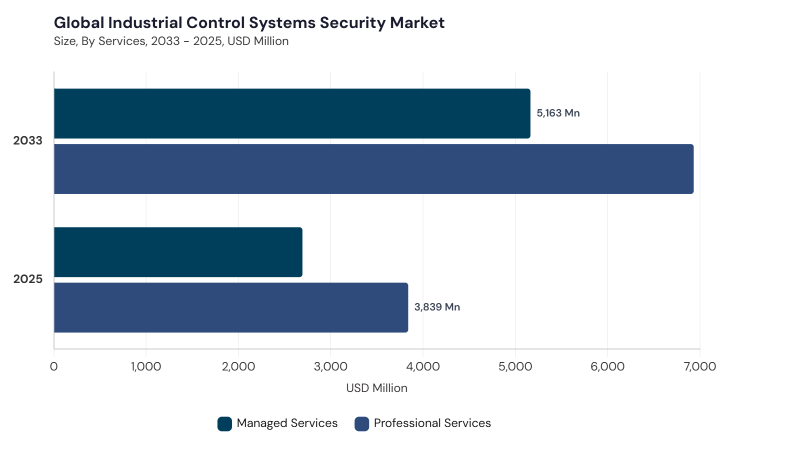
On the basis of component, the Industrial Control Systems Security market is classified into Solution and Services. The Solution segment acquired the largest revenue share in the market in 2025. The increasing need for advanced cybersecurity tools such as firewalls, intrusion detection systems, SIEM platforms, and encryption solutions to protect industrial infrastructure from sophisticated cyber threats is driving the growth of this segment. Organizations across manufacturing, energy, and transportation sectors are increasingly investing in integrated security solutions to strengthen operational resilience.
Based on security type, the Industrial Control Systems Security market is classified into Network, Endpoint, Application, and Database. The Network segment dominated the market in 2025 owing to the growing need to secure industrial communication networks and protect operational technology systems from cyberattacks. Rising deployment of connected industrial devices and increasing integration of IT and OT systems are further driving demand for network security solutions across industrial environments.
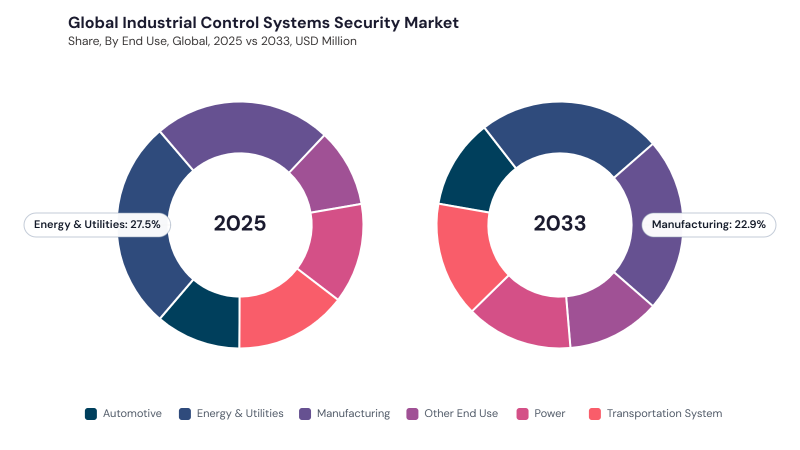
By end use, the Industrial Control Systems Security market is divided into Energy & Utilities, Manufacturing, Transportation Systems, Power, Automotive, and Other End Use. The Energy & Utilities segment acquired the largest revenue share in the market in 2025. Critical infrastructure facilities such as power grids, oil & gas facilities, and utility networks are increasingly vulnerable to cyber threats, driving substantial investments in industrial cybersecurity solutions to ensure operational continuity and infrastructure protection.
Free Valuable Insights: Industrial Control Systems Security Market Size to reach $38.03 Billion by 2033
Region-wise, the Industrial Control Systems Security Market is analyzed across North America, Europe, Asia Pacific, and LAMEA. The North America segment recorded the largest revenue share in the market in 2025. The dominance of the region is driven by advanced industrial infrastructure, early adoption of digital technologies, strong regulatory frameworks, and increasing cybersecurity investments across critical infrastructure sectors including manufacturing, utilities, and transportation.
Europe continues to witness strong market growth supported by stringent cybersecurity regulations and growing investments in industrial automation security. Meanwhile, Asia Pacific is emerging as a fast-growing region due to rapid industrialization, expansion of manufacturing capabilities, and increasing adoption of Industry 4.0 technologies across countries such as China, India, and Japan.
The Industrial Control Systems Security market is highly competitive and characterized by increasing adoption of AI-powered threat detection, automation, and integrated IT-OT cybersecurity frameworks. Vendors are differentiating themselves through advanced industrial monitoring capabilities, real-time anomaly detection, and scalable cybersecurity architectures designed specifically for operational technology environments.
Strategic partnerships between cybersecurity providers, industrial automation companies, and cloud platform vendors are strengthening integrated security ecosystems across industrial sectors. Flexible deployment models, cloud-enabled industrial monitoring, and interoperability with legacy infrastructure are also becoming important competitive differentiators influencing customer adoption decisions.
| Report Attribute | Details |
|---|---|
| Market size value in 2026 | USD 22.56 Billion |
| Market size forecast in 2033 | USD 38.03 Billion |
| Base Year | 2025 |
| Historical period | 2022 to 2024 |
| Forecast Period | 2026 to 2033 |
| Revenue Growth Rate | CAGR of 6.8% from 2026 to 2033 |
| Number of Pages | 821 |
| Tables | 1080 |
| Report Coverage | Market Trends, Revenue Estimation and Forecast, Segmentation Analysis, Regional and Country Breakdown, Competitive Landscape, Market Share Analysis, Company Profiling, Strategic Developments, SWOT Analysis, Winning Imperatives |
| Segments Covered | Component, Security Type, End Use, Region |
| Country Scope |
|
| Companies Included | Siemens AG, Honeywell International Inc., Schneider Electric SE, ABB Ltd., Fortinet, Inc., Palo Alto Networks, Inc., Cisco Systems, Inc., Check Point Software Technologies Ltd., Broadcom Inc., Microsoft Corporation |
By Component
By Security Type
By End Use
By Geography
Valued at USD 22.56 billion in 2026, reaching USD 38.03 billion by 2033. Growing at 6.8% CAGR during 2026-2033.
Solution segment dominates with 69.10% market share in 2025. Projected to reach USD 25.94 billion by 2033 at 7.6% CAGR during the forecast period.
Siemens AG, Honeywell International Inc., Schneider Electric SE, ABB Ltd., and Fortinet hold dominant positions.
North America dominates with 35.92% revenue share in 2025. Expected to reach USD 12.93 billion by 2033 at 7.0% CAGR during the forecast period.
Escalating cyberattacks targeting industrial systems, regulatory compliance mandates, and advanced technology integration for proactive cybersecurity.
Energy & Utilities leads with 27.47% market share in 2025. Reaching USD 9.16 billion by 2033 at 5.9% CAGR during the forecast period.
Our team of dedicated experts can provide you with attractive expansion opportunities for your business.








 Unique Offerings