The Latin America, Middle East and Africa Cognitive Radio Market would witness market growth of 16.7% CAGR during the forecast period (2025-2032).
The Brazil market dominated the LAMEA Cognitive Radio Market by Country in 2024, and would continue to be a dominant market till 2032; thereby, achieving a market value of $506.1 million by 2032. The Argentina market is showcasing a CAGR of 17.6% during (2025 - 2032). Additionally, The UAE market would register a CAGR of 15.8% during (2025 - 2032). The Brazil and UAE led the LAMEA Cognitive Radio Market by Country with a market share of 21.2% and 17.6% in 2024. The South Africa market is expected to witness a CAGR of 17.6% during throughout the forecast period.
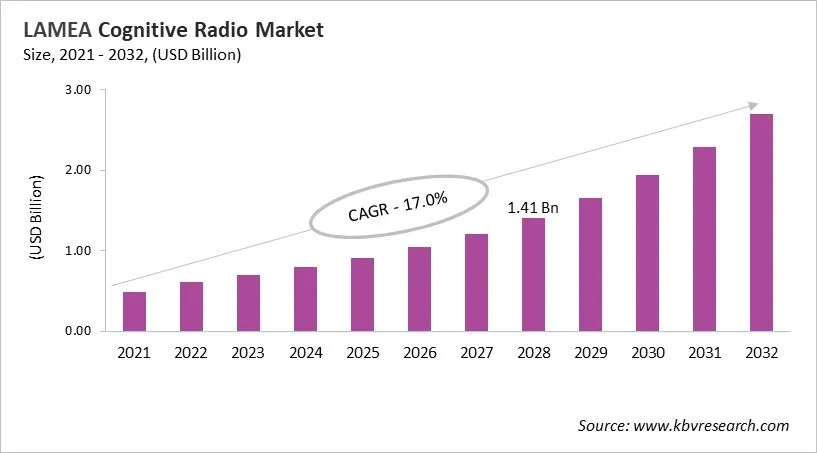
The LAMEA Cognitive Radio Market is growing steadily as governments, regulators, and telecom companies work to make better use of the spectrum to deal with problems like congestion, uneven broadband access, and rising demand for connectivity. Dynamic spectrum access, software-defined radio, and AI-enabled communication systems are becoming more popular in Africa, the Middle East, and Latin America because of national digital transformation efforts, smart city programs, and goals for connecting rural areas. OEMs like Huawei, Ericsson, ZTE, and Samsung help this growth by constantly coming up with new ideas for intelligent spectrum sensing, adaptive radio platforms, and scalable SDR technologies that can be used in both cities and remote areas.
Demand for reliable communication in mission-critical industries like oil and gas, mining, defense, transportation, and public safety is rising. Cognitive radio makes communication more reliable and less likely to be interrupted, which boosts market momentum even more. Governments and telecom companies are using shared-spectrum frameworks more and more. At the same time, important companies are forming strategic partnerships with regulators like ANATEL, ICASA, and Middle Eastern ICT authorities to make sure that technologies are in line with national broadband goals. As competition heats up, global OEMs and new regional providers are expanding their reach by offering cognitive radio solutions that are tailored to each customer's needs, cost-effective, and high-performance. These solutions speed up the digital modernization process in the LAMEA region.
Based on Component, the market is segmented into Hardware, Software and Services. The Hardware market segment dominated the UAE Cognitive Radio Market by Component is expected to grow at a CAGR of 15.1 % during the forecast period thereby continuing its dominance until 2032. Also, The Software market is anticipated to grow as a CAGR of 16.2 % during the forecast period during (2025 - 2032).
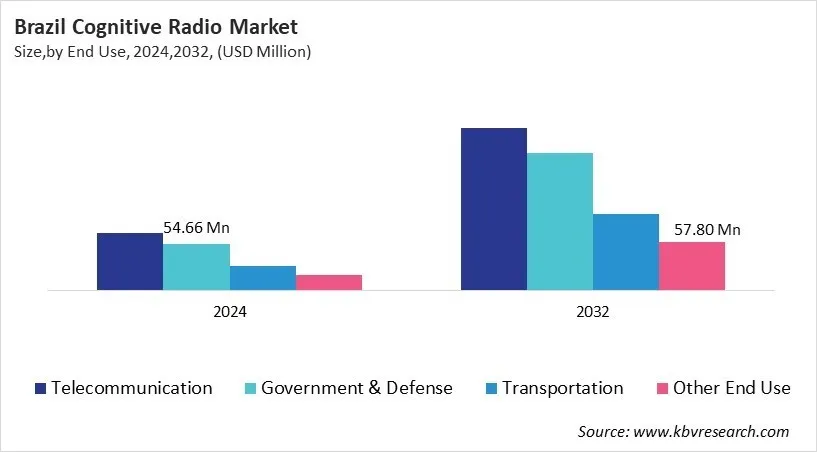
Based on End Use, the market is segmented into Telecommunication, Government & Defense, Transportation and Other End Use. With a compound annual growth rate (CAGR) of 14.2% over the projection period, the Telecommunication Market, dominate the Brazil Cognitive Radio Market by End Use in 2024 and would be a prominent market until 2032. The Transportation market is expected to witness a CAGR of 15.9% during (2025 - 2032).
Free Valuable Insights: The Worldwide Cognitive Radio Market is Projected to reach USD 27.94 Billion by 2032, at a CAGR of 15.0%
Brazil's cognitive radio market is growing because more people want wireless service, there isn't enough spectrum, and the government wants to make the country more digital. ANATEL is modernizing spectrum management and encouraging dynamic spectrum access. People are interested in smart, adaptive radio systems that improve coverage and resilience because the country's geography is so varied, from big cities to remote areas of the Amazon. Some of the most important trends are adding cognitive capabilities to 5G networks, using SDR platforms for public safety, and using adaptive communication in fields like mining, farming, and energy. Major OEMs like Huawei, Ericsson, and Nokia, as well as local integrators who help with the development of 5G and private networks, shape the competition. In general, Brazil's telecom and industrial sectors are adopting cognitive radio more quickly because of changing shared-spectrum policies and more government efforts to connect people.

By Component
By End Use
By Application
By Country
Our team of dedicated experts can provide you with attractive expansion opportunities for your business.



 Unique Offerings