The Latin America, Middle East and Africa Piezoelectric Materials Market is expected to reach $134.55 billion by 2028 and would witness market growth of 5.6% CAGR during the forecast period (2025-2032).
The Brazil market dominated the LAMEA Piezoelectric Materials Market by Country in 2024, and would continue to be a dominant market till 2032; thereby, achieving a market value of $44.7 million by 2032. The Argentina market is showcasing a CAGR of 6.2% during (2025 - 2032). Additionally, The UAE market would register a CAGR of 4.4% during (2025 - 2032). The Brazil and UAE led the LAMEA Piezoelectric Materials Market by Country with a market share of 28.8% and 12.6% in 2024. The Nigeria market is expected to witness a CAGR of 7.6% during throughout the forecast period.
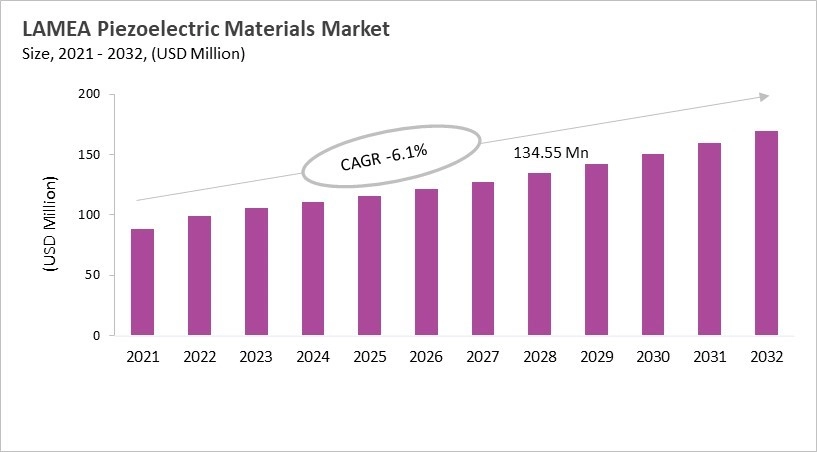
The LAMEA piezoelectric materials market, which includes Latin America, the Middle East, and Africa, has grown slowly compared to more developed areas. This is mostly because of industrial modernization, infrastructure expansion, and the use of new sensing technologies. In the beginning, the market grew because of imported industrial equipment and sensors instead of local manufacturing. The first uses were in the oil and gas, power generation, and mining industries, where they were used to monitor vibrations, measure pressure, and diagnose equipment problems. As regional economies grew, manufacturing automation, smart infrastructure, and transportation systems became more common. This was made possible by government programs, technology transfer programs, and public development projects that aimed to make businesses more efficient and safer.
Global OEMs like Siemens, Bosch, TDK, and Murata Manufacturing dominate the LAMEA market by providing standardized, reliable piezoelectric parts that are used in building management systems, energy infrastructure, and industrial automation. Market strategies focus on using technology, integrating systems, having a local presence, and making designs that can handle tough working conditions. The competitive landscape is less stable, and companies compete based on their knowledge of applications, service networks, and reliability instead of the cost or quantity of raw materials they produce. Investments in public infrastructure, smart city projects, and predictive maintenance are still driving demand. This makes piezoelectric-enabled solutions important for improving industrial efficiency, energy resilience, and digital transformation in the region.
Based on End-use, the market is segmented into Automotive, Healthcare, Information & Telecom, Consumer Goods and Other End-use. With a compound annual growth rate (CAGR) of 3% over the projection period, the Automotive Market, dominate the Brazil Piezoelectric Materials Market by End-use in 2024 and would be a prominent market until 2032. The Consumer Goods market is expected to witness a CAGR of 5.6% during (2025 - 2032).
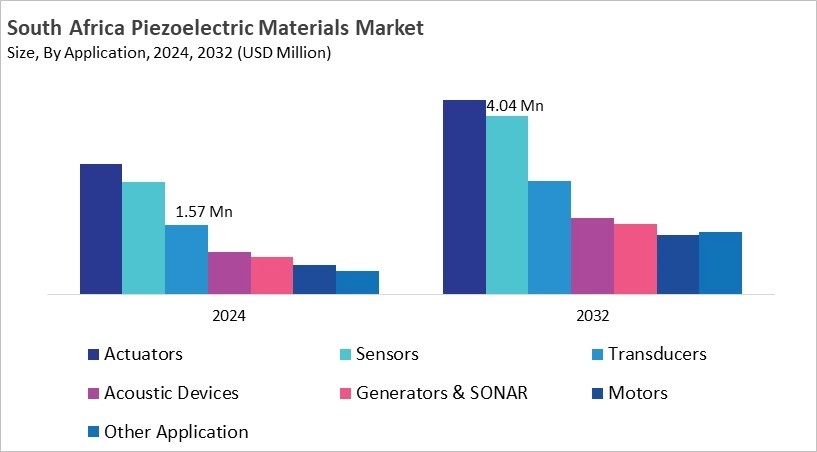
Based on Application, the market is segmented into Actuators, Sensors, Transducers, Acoustic Devices, Generators & SONAR, Motors and Other Application. Among various South Africa Piezoelectric Materials Market by Application; The Actuators market achieved a market size of USD $3 Million in 2024 and is expected to grow at a CAGR of 5.3 % during the forecast period. The Generators & SONAR market is predicted to experience a CAGR of 8.3% throughout the forecast period from (2025 - 2032).
Free Valuable Insights: Piezoelectric Materials Market Size Worth USD 2.01 billion by 2032
The piezoelectric materials market in Brazil is mostly driven by the use of high-performance parts from global OEMs instead of local manufacturing. Key players like APC International and Piezo Direct provide actuators, sensors, transducers, and custom ceramic shapes. These parts are used a lot in Brazil's automotive, aerospace, medical, and industrial automation industries for things like monitoring vibrations, controlling things with precision, and collecting energy. The growing use of smart infrastructure and IoT-enabled systems is driving up demand for small, reliable, and sensitive piezoelectric devices. At the same time, competition among global suppliers is focused on delivery, customization, and technical support. As Brazilian OEMs and research institutions use more advanced piezo technologies, the market is ready to keep growing thanks to automation, smart manufacturing, and renewable energy projects.

By End-use
By Application
By Material Type
By Country
Our team of dedicated experts can provide you with attractive expansion opportunities for your business.






 Unique Offerings