The North America Piezoelectric Materials Market is expected to reach $457.95 million by 2028 and would witness market growth of 3.9% CAGR during the forecast period (2025-2032).
The US market dominated the North America Piezoelectric Materials Market by Country in 2024, and would continue to be a dominant market till 2032; thereby, achieving a market value of $363.3 million by 2032. The Canada market is experiencing a CAGR of 5.8% during (2025 - 2032). Additionally, The Mexico market would exhibit a CAGR of 5% during (2025 - 2032). The US and Canada led the North America Piezoelectric Materials Market by Country with a market share of 71.2% and 14.3% in 2024.
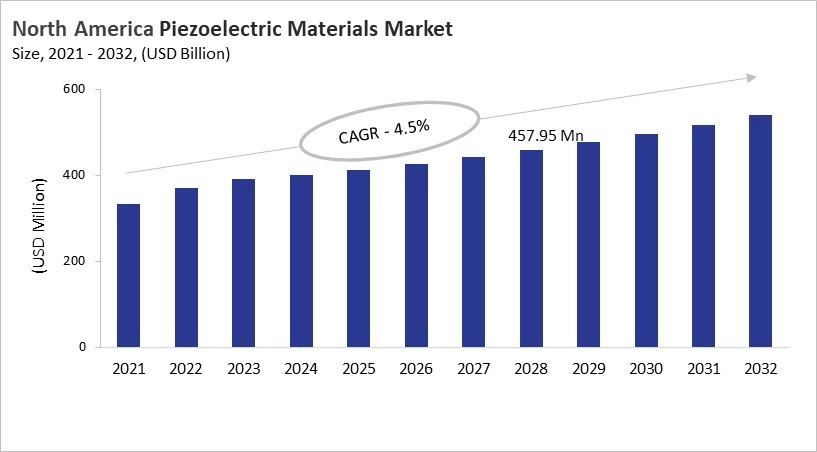
The North American market for piezoelectric materials has grown thanks to a strong base in advanced manufacturing, defense research, electronics innovation, and industrial automation. Piezoelectric materials were first used in defense, aerospace, and laboratory instruments. As manufacturing processes improved and OEMs like CTS Corporation, Murata Manufacturing, TDK Electronics, and PI Ceramic increased production for the industrial, automotive, and medical sectors, they began to be used in commercial settings as well. The rise of electronics, robotics, semiconductor manufacturing, and automation greatly increased demand. Piezoelectric actuators and sensors made it possible to precisely control motion, monitor vibrations, and sense conditions. In recent years, the use of electric vehicles, advanced driver assistance systems (ADAS), Internet of Things (IoT) systems, smart infrastructure, and medical devices has grown even faster. This is because of environmental initiatives that promote lead-free, sustainable materials.
Some important market trends are more integration in industrial automation and precision manufacturing, automotive sensing and safety systems, and energy harvesting for clean infrastructure. OEM strategies focus on investing in research and development, improving the composition of materials, creating multilayer structures, and customizing products for specific uses in the medical, automotive, and industrial fields. Having a presence in North America and a strong supply chain helps build relationships with local customers and makes sure that regional standards are met. The market is still only moderately consolidated. Competition is based on factors other than price, such as technological differentiation, reliability, and compliance. This favors companies that can adapt their innovations to North America's changing industrial, regulatory, and sustainability landscape.
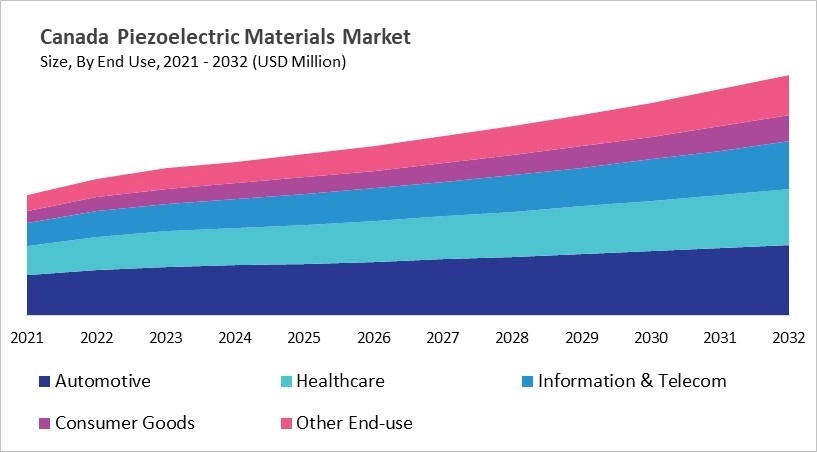
Based on End-use, the market is segmented into Automotive, Healthcare, Information & Telecom, Consumer Goods and Other End-use. With a compound annual growth rate (CAGR) of 4.4% over the projection period, the Automotive Market, dominate the Canada Piezoelectric Materials Market by End-use in 2024 and would be a prominent market until 2032. The Consumer Goods market is expected to witness a CAGR of 7% during (2025 - 2032).
Based on Material Type, the market is segmented into Ceramics, Polymers, Composites and Other Material Type. Among various US Piezoelectric Materials Market by Material Type; The Ceramics market achieved a market size of USD $147.8 Million in 2024 and is expected to grow at a CAGR of 2.3 % during the forecast period. The Polymers market is predicted to experience a CAGR of 3.4% throughout the forecast period from (2025 - 2032).
Free Valuable Insights: The Global Piezoelectric Materials Market will hit USD 2.01 billion by 2032, at a CAGR of 4.4%
The United States Piezoelectric Materials Market is based on advanced industrial technology uses, and it is very important in the aerospace, automotive, healthcare, and industrial automation fields. Companies like PCB Piezotronics, Piezo Direct, and CTS Corporation make high-precision piezoelectric sensors, actuators, and multilayer stacks that are essential for controlling vibrations, monitoring pressure, and sensing motion. These products must meet strict performance and durability standards in a wide range of thermal and mechanical conditions. Market trends show that predictive maintenance, industrial IoT, and small MEMS parts for smart manufacturing and automation are becoming more popular. Competition comes from both well-known sensor makers and niche materials makers, who focus on custom solutions and integrating them with microelectronic signal conditioning. Future innovations will focus on energy harvesting, high-frequency ultrasonic applications, and multifunctional sensing systems. These will be made possible by strong US research and development partnerships, which will lead to wider use in both industrial and consumer products.

By End-use
By Application
By Material Type
By Country
Our team of dedicated experts can provide you with attractive expansion opportunities for your business.








 Unique Offerings