The North America Software Defined Data Center Market would witness market growth of 28.7% CAGR during the forecast period (2025-2032).
The US market dominated the North America Software Defined Data Center Market by Country in 2024, and would continue to be a dominant market till 2032; thereby, achieving a market value of $152,636.8 million by 2032. The Canada market is experiencing a CAGR of 31.7% during (2025 - 2032). Additionally, The Mexico market would showcase a CAGR of 30.6% during (2025 - 2032). The US and Canada led the North America Software Defined Data Center Market by Country with a market share of 78.1% and 10.9% in 2024.
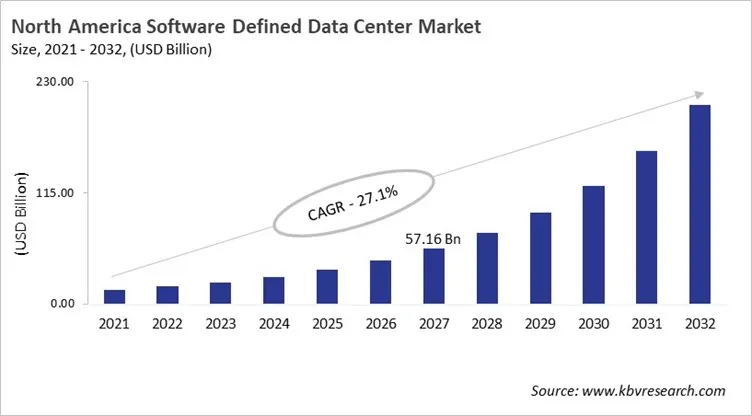
The North American Software Defined Data Center market has changed quickly because virtualization, hybrid cloud, and automation-led digital strategies have become very popular. The area became an early leader because of government modernization efforts and a well-developed technology ecosystem. SDDC grew from just compute virtualization to include networking, storage, and full-stack automation. This made it possible to create data center environments that could be scaled, programmed, and controlled by policies. The market was also shaped by trends like hybrid and multi-cloud architectures, containerization, and edge computing. As businesses modernized their IT operations, AI-driven automation, workload portability, and resilient infrastructure became top priorities.
Current market trends show that AIOps, hybrid and multi-cloud management, and software-defined security are all coming together quickly to deal with complexity, cyber threats, and changing rules. Zero Trust and micro-segmentation are two security methods that are becoming more common in virtualized layers of SDDC. The competitive landscape is still changing, thanks to established tech companies, hyperscalers, and new cloud-native infrastructure providers. Strategic focus areas include investing in research and development, working with other companies in the ecosystem, making sure that different clouds can work together, and working on projects that are good for the environment. As companies put more value on being flexible, saving money, and being able to handle digital threats, SDDC moves closer to fully autonomous and intelligent data center models.
Based on End Use, the market is segmented into IT & Telecom, BFSI, Government & Defense, Healthcare, Manufacturing, Retail & eCommerce and Other End Use. Among various US Software Defined Data Center Market by End Use; The IT & Telecom market achieved a market size of USD $5891.6 Million in 2024 and is expected to grow at a CAGR of 25.7 % during the forecast period. The Retail & eCommerce market is predicted to experience a CAGR of 30% throughout the forecast period from (2025 - 2032).
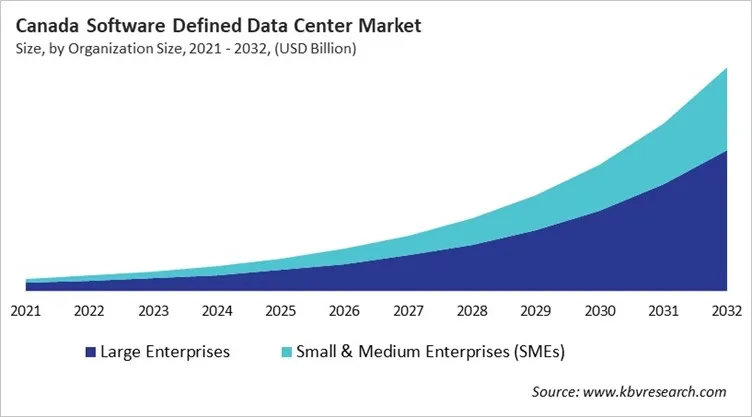
Based on Organization Size, the market is segmented into Large Enterprises and Small & Medium Enterprises (SMEs). The Large Enterprises market segment dominated the Canada Software Defined Data Center Market by Organization Size is expected to grow at a CAGR of 31.4 % during the forecast period thereby continuing its dominance until 2032. Also, The Small & Medium Enterprises (SMEs) market is anticipated to grow as a CAGR of 32.4 % during the forecast period during (2025 - 2032).
Free Valuable Insights: The Software Defined Data Center Market is Predicted to reach USD 534.75 Billion by 2032, at a CAGR of 29.3%
The US has the biggest and most advanced Software Defined Data Center market because it was one of the first countries to use virtualization, hybrid cloud, and federal digital modernization programs. Best practices for automation, security, and cloud interoperability are still shaped by government rules and NIST frameworks. Digital businesses, telecom, healthcare, and finance are all pushing for faster adoption, along with the growth of AI, 5G, and data-heavy workloads. Some important trends are the fast growth of hybrid cloud, AIOps, edge integration, Infrastructure-as-Code, and automated cybersecurity. Competition is still fierce, with technology vendors, hyperscalers, and telecom operators all offering different automation and multi-cloud features.

By Organization Size
By Component
By Deployment
By Type
By End Use
By Country
Our team of dedicated experts can provide you with attractive expansion opportunities for your business.



 Unique Offerings