“Global Piezoelectric Materials Market to reach a market value of USD 2.01 Billion by 2032 growing at a CAGR of 4.4%”
The Global Piezoelectric Materials Market size is estimated at $1.49 billion in 2025 and is expected to reach $2.01 billion by 2032, rising at a market growth of 4.4% CAGR during the forecast period (2025-2032). The growth of this market is justified by rising demand from automotive electronics, medical devices, industrial automation, and consumer electronics, alongside ongoing advancements in sensors, actuators, and energy-harvesting technologies, which collectively support steady adoption and sustained CAGR-driven revenue expansion.
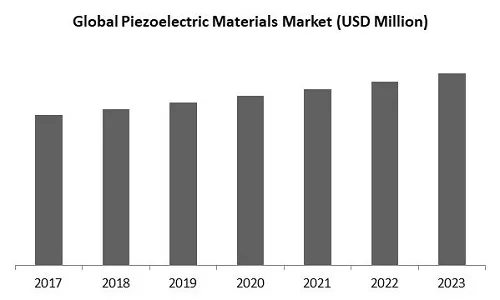
The unique property of the piezoelectric materials to convert the mechanical energy into electrical signals and vice versa, propelling the growth of the piezoelectric materials market. These materials plays an important role across industrial, automotive, and consumer electronics, IoT applications. The technology has transformed from initial quartz-based materials to well-engineered ceramic piezomaterials which gives scalability, higher performance, and cost efficiency. Growth in multilayer ceramic designs, miniaturization, and integration have provided compact, high-precision components used in automotive safety systems, smart devices, industrial automation, and growing sectors like energy harvesting and biomedical devices.
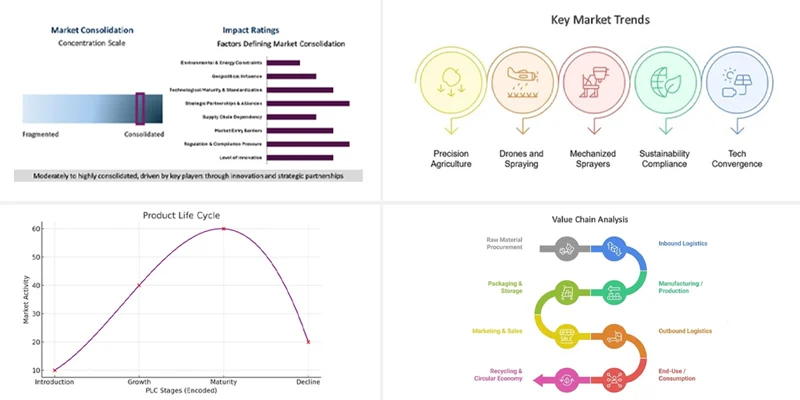
Key trends in the market include continued miniaturization of components, wider adoption in automotive and industrial applications, and a growing emphasis on sustainability through the use of lead-free and environmentally compliant materials. Major OEMs such as Murata Manufacturing and TDK Corporation are making significant investments in research and development to improve performance, offer customized solutions, and support large-scale production through their global operations. The market remains competitive, with established players leveraging scale, reliability, and technical expertise, while specialized manufacturers focus on niche, high-precision applications. Together, ongoing material innovation, expanding use cases, and sustainability efforts are driving the steady growth and diversification of the global piezoelectric materials market.

The COVID-19 pandemic had a big effect on the Piezoelectric Materials Market. This was mostly because of widespread problems with manufacturing and the supply chain, especially in the Asia-Pacific region, which is a major production hub. Lockdowns and restrictions on movement caused factories to close for a short time, made it harder to get raw materials, and lowered production capacity, all of which made it harder to fill orders. As production slowed and infrastructure projects were put on hold, demand from big end-use industries like automotive, industrial manufacturing, and consumer electronics fell sharply. The electronics and semiconductor industries were hurt even more by problems with the supply chain, a lack of workers, and inefficient operations. This made it harder to make devices that rely on piezoelectric components. Also, small and medium-sized manufacturers had money problems that made them cut back on research and development and capacity expansion. This slowed down the introduction of new materials and new ideas. Thus, the COVID-19 pandemic had a negative impact on the market.
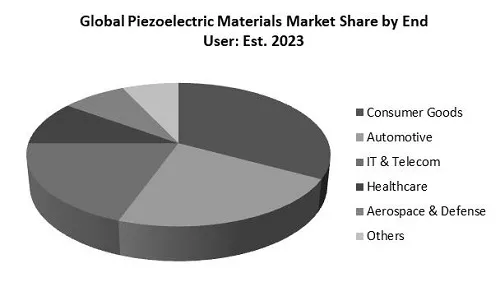
Based on End-use, the market is segmented into Automotive, Healthcare, Information & Telecom, Consumer Goods and Other End-use. The Healthcare segment attained 24.27% revenue share in the market in 2024. The Healthcare segment represents a significant end-use area for piezoelectric materials due to their critical role in medical diagnostics and treatment technologies. These materials are widely employed in ultrasonic imaging devices, sonography equipment, surgical instruments, and precision monitoring systems. Their ability to generate high-frequency vibrations and convert mechanical energy into electrical signals enables highly accurate imaging and patient monitoring.
Based on Application, the market is segmented into Actuators, Sensors, Transducers, Acoustic Devices, Generators & SONAR, Motors and Other Application. The Sensors segment attained 24.22% revenue share in the market in 2024. The Sensors segment represents a key application area for piezoelectric materials due to their exceptional ability to detect and convert mechanical changes into measurable electrical signals. Piezoelectric sensors are employed across sectors such as automotive, healthcare, industrial automation, and consumer electronics to monitor pressure, force, acceleration, and vibration.
Free Valuable Insights: Piezoelectric Materials Market Size to reach $2.01 by 2032
Region-wise, the Piezoelectric Materials Market is analyzed across North America, Europe, Asia Pacific, and LAMEA. The Asia Pacific segment recorded 42.30% revenue share in the market in 2024. North America and Europe are well-established markets for piezoelectric materials, supported by strong industrial capabilities, advanced automotive production, and ongoing investment in research and development. In North America, demand is largely driven by use cases in industrial automation, medical devices, aerospace, and high-end automotive systems that require precision and reliability. Europe remains a close follower, with growth supported by a strong automotive industry, strict environmental standards, and an increasing focus on lead-free and sustainable material solutions. Continued emphasis on smart manufacturing, electric vehicles, and Industry 4.0 initiatives further drives the steady adoption of advanced piezoelectric components across a wide range of industries.
Asia Pacific and LAMEA are emerging as fast-growing regions, driven by expanding electronics manufacturing, rapid industrial growth, and increasing adoption of smart technologies. Asia Pacific, led by countries such as Japan, China, and South Korea, acts as a global center for consumer electronics and automotive production, creating strong demand for piezoelectric sensors and actuators. At the same time, LAMEA is seeing steady progress as investments rise in industrial automation, infrastructure, and healthcare, with piezoelectric materials gaining wider use in sensing, energy harvesting, and control applications, positioning the region as an attractive long-term growth market.
| Report Attribute | Details |
|---|---|
| Market size value in 2025 | USD 1.49 Billion |
| Market size forecast in 2032 | USD 2.01 Billion |
| Base Year | 2024 |
| Historical period | 2021 to 2023 |
| Forecast Period | 2025 to 2032 |
| Revenue Growth Rate | CAGR of 4.4% from 2025 to 2032 |
| Number of Pages | 551 |
| Tables | 425 |
| Report Coverage | Market Trends, Revenue Estimation and Forecast, Segmentation Analysis, Regional and Country Breakdown, Porter’s 5 Forces Analysis, Company Profiling, Companies Strategic Developments, SWOT Analysis, Winning Imperatives |
| Segments Covered | Material Type, End-use, Application, Region |
| Country Scope |
|
| Companies Included | L3Harris Technologies, Inc., Piezosystem Jena GmbH, Mad City Labs, Inc., TDK Corporation, Arkema S.A., Kemet Corporation, Solvay SA, TE Connectivity Ltd., Kistler Group (Kistler Holding AG), and Morgan Advanced Materials PLC |
By End-use
By Application
By Material Type
By Geography
Our team of dedicated experts can provide you with attractive expansion opportunities for your business.












 Unique Offerings