“Global Web Filtering Market to reach a market value of USD 10.26 Billion by 2032 growing at a CAGR of 11.7%”
The Global Web Filtering Market size is expected to reach USD 10.26 billion by 2032, rising at a market growth of 11.7% CAGR during the forecast period.
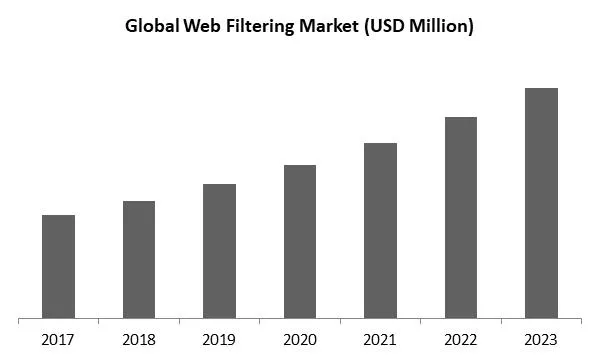
The web filtering market has developed substantially into a core component of cybersecurity and compliance strategies for enterprises. Web filtering solutions categorize, monitor, and block access to web content to protect against cyber threats like phishing and malware, ensure regulatory compliance, and enforce policies. Web filtering was largely integrated through on-premises appliances aimed at controlling content in libraries, businesses, and schools. With growing cyber threats and regulatory demands, the web filtering market shifted towards more advanced solutions that included encrypted traffic inspection, policy controls, malware protection, particularly as workforces become more distributed. The growth of cloud computing, remote environments, and mobile work further propelled the demand for cloud-based web filtering solution, which enabled scalable protection beyond traditional corporate perimeters. These solutions are also deployed into broader security systems, like zero-trust frameworks, secure web gateways, representing the strategic role web filtering now plays in enterprise security.
The utilization of machine learning and AI for real-time content analysis and dynamic classification has become essential as web threats develop more rapidly. Web filtering solutions are largely integrated with broader security and productivity platforms, going beyond simple content blocking to support compliance enforcement, data-loss prevention, and detailed user-behaviour monitoring. Providers are focusing on platform expansion, offering cloud-first solutions and tailored approaches for regulatory requirements and different industries. The web filtering market seems to be competitive with large cybersecurity firms and specialized web filtering companies seeking market position. The market is shifting towards a more strategic approach to security, with web filtering now considered as an essential part of an organization’s broader compliance and cybersecurity frameworks.
The Covid-19 pandemic sped up the use of web filtering tools as more people started working and learning online. Companies needed to better protect their workers who accessed company systems from home networks that weren't secure. This led to a rise in demand for malware blocking, phishing prevention, and safe browsing controls. Schools and colleges also used filtering tools to make sure that students were safe while they were learning online. The rise in cyber threats, such as ransomware and phishing campaigns, made the need for web filtering even stronger. Cloud-based security platforms have become popular because they can grow with your needs, can be managed from anywhere, and are cost-effective. This made them a popular choice for teams that work from different locations and helped the market grow during the pandemic. Thus, the COVID-19 pandemic had a positive impact on the market.

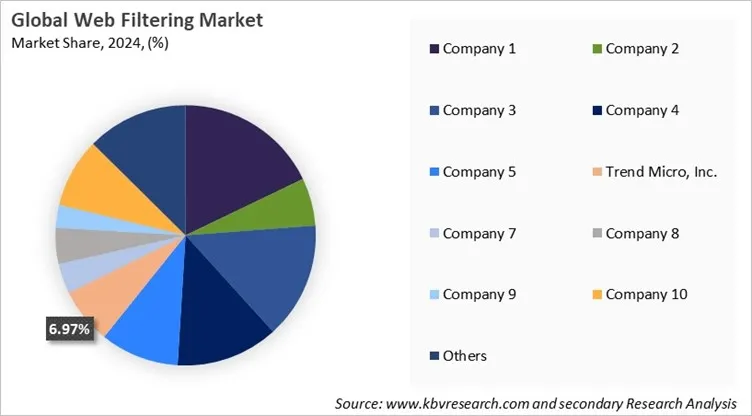
The leading players in the market are competing with diverse innovative offerings to remain competitive in the market. The above illustration shows the percentage of revenue shared by some of the leading companies in the market. The leading players of the market are adopting various strategies in order to cater demand coming from the different industries. The key developmental strategies in the market are Acquisitions, and Partnerships & Collaborations.
Based on organisation size, the web filtering market is characterized into large enterprise and small & medium enterprise (SME). The small & medium enterprise (SME) segment attained 30% revenue share in the web filtering market in 2024. The small & medium enterprise segment consists of organizations with more compact operational structures and relatively streamlined IT environments. These businesses often seek web filtering solutions that provide essential protection, straightforward management, and cost-efficient deployment across their workforce. Their focus tends to be on achieving reliable security measures, ensuring safe internet usage, and supporting productivity without the complexity of enterprise-grade systems.
By deployment mode, the web filtering market is divided into on-premises and cloud. The cloud segment recorded 33% revenue share in the web filtering market in 2024. The cloud segment includes deployment models delivered through remote servers, offering flexibility, scalability, and simplified management. This approach appeals to organizations seeking faster implementation, reduced hardware dependency, and seamless updates. Cloud-based web filtering supports distributed workforces, enabling protection for users regardless of location.
Free Valuable Insights: Web Filtering Market size to reach USD 10.26 Billion by 2032
Region-wise, the web filtering market is analyzed across North America, Europe, Asia Pacific, and LAMEA. The North America segment recorded 36% revenue share in the web filtering market in 2024. The web filtering market is anticipated to grow significantly in the North America and Europe regions. The market is driven by mature security ecosystems, large enterprise spending, and a prominent concentration of vendors and managed service providers. Further, the adoption is encouraged by remote/hybrid work models, stringent industry compliance requirements in industries such as healthcare and finance, and ongoing cloud migration that favors integrated filtering services. In addition to this, the European web filtering market is witnessing prominent expansion. This is due to public-sector procurement, strong privacy and regulatory regimes, and a shift toward cloud and unified threat management across enterprises.
In Asia Pacific and LAMEA, the web filtering market is predicted to procure a prominent share in the upcoming years. The increasing internet penetration, rising cybersecurity investment, and rapid digitalisation in nations like Southeast Asia, India, and China are some of the elements supporting the market growth. Moreover, the LAMEA web filtering market is growing steadily. The market is expanding, backed by greater awareness of cyberthreats, telecom infrastructure upgrades, government initiatives to protect public networks, and protect schools, though adoption lags developed regions in per-capita spending. The growth opportunities in the web filtering market is supported by AI-assisted threat detection, cloud native filtering, and convergence with broader secure access/service edge (SASE) stacks.
| Report Attribute | Details |
|---|---|
| Market size value in 2025 | USD 4.71 Billion |
| Market size forecast in 2032 | USD 10.26 Billion |
| Base Year | 2024 |
| Historical Period | 2021 to 2023 |
| Forecast Period | 2025 to 2032 |
| Revenue Growth Rate | CAGR of 11.7% from 2025 to 2032 |
| Number of Pages | 599 |
| Number of Tables | 531 |
| Report coverage | Market Trends, Revenue Estimation and Forecast, Segmentation Analysis, Regional and Country Breakdown, Market Share Analysis, Porter’s 5 Forces Analysis, Company Profiling, Companies Strategic Developments, SWOT Analysis, Winning Imperatives |
| Segments covered | Organisation Size, Industry Vertical, Component, Deployment Mode, Filtering Type, Region |
| Country scope |
|
| Companies Included | Cisco Systems, Inc., McAfee LLC, Palo Alto Networks, Inc., Fortinet, Inc., Broadcom, Inc. (Symantec Corporation), Trend Micro, Inc., Forcepoint LLC (Francisco Partners), Sophos Group PLC (Thomas Bravo), Barracuda Networks, Inc. (KKR & Co. Inc.) and Zscaler Inc. |
By Organization Size
By Industry Vertical
By Component
By Deployment Mode
By Filtering Type
By Geography
The market size is projected to reach USD 10.26 Billion by 203
The web filtering market is projected to grow at a CAGR of 11.7% between 2025 and 2032.
Rising cybersecurity threats across digital ecosystems alongside the expansion of cloud adoption and distributed workforces.
Cisco Systems, Inc., McAfee LLC, Palo Alto Networks, Inc., Fortinet, Inc., Broadcom, Inc. (Symantec Corporation), Trend Micro, Inc., Forcepoint LLC (Francisco Partners), Sophos Group PLC (Thomas Bravo), Barracuda Networks, Inc. (KKR & Co. Inc.) and Zscaler Inc.
The Solution segment dominated the Global Web Filtering Market by Component in 2024, and would continue to be a dominant market till 2032; thereby, achieving a market value of $6.17 billion by 2032.
The North America region dominated the Global Web Filtering Market by Region in 2024, and would continue to be a dominant market till 2032; thereby, achieving a market value of $3.59 billion by 2032.
Our team of dedicated experts can provide you with attractive expansion opportunities for your business.












 Unique Offerings