
 5G Router Market
Total Market Chart
Global 5G Router Market
5G Router Market: Evolution, Emerging Trends & Competitive Landscape
Evolution of the 5G Router Market
The 5G router market emerged alongside the initial rollout of 5G wireless technology, which was developed to overcome the limitations of previous cellular generations by delivering higher data speeds, ultra-low latency, and massive device connectivity.
Early development focused on adapting router technology to utilize new spectrum bands and advanced network architectures. This required significant improvements in wireless chipset integration, antenna design, and firmware capable of handling increasingly complex 5G protocols.
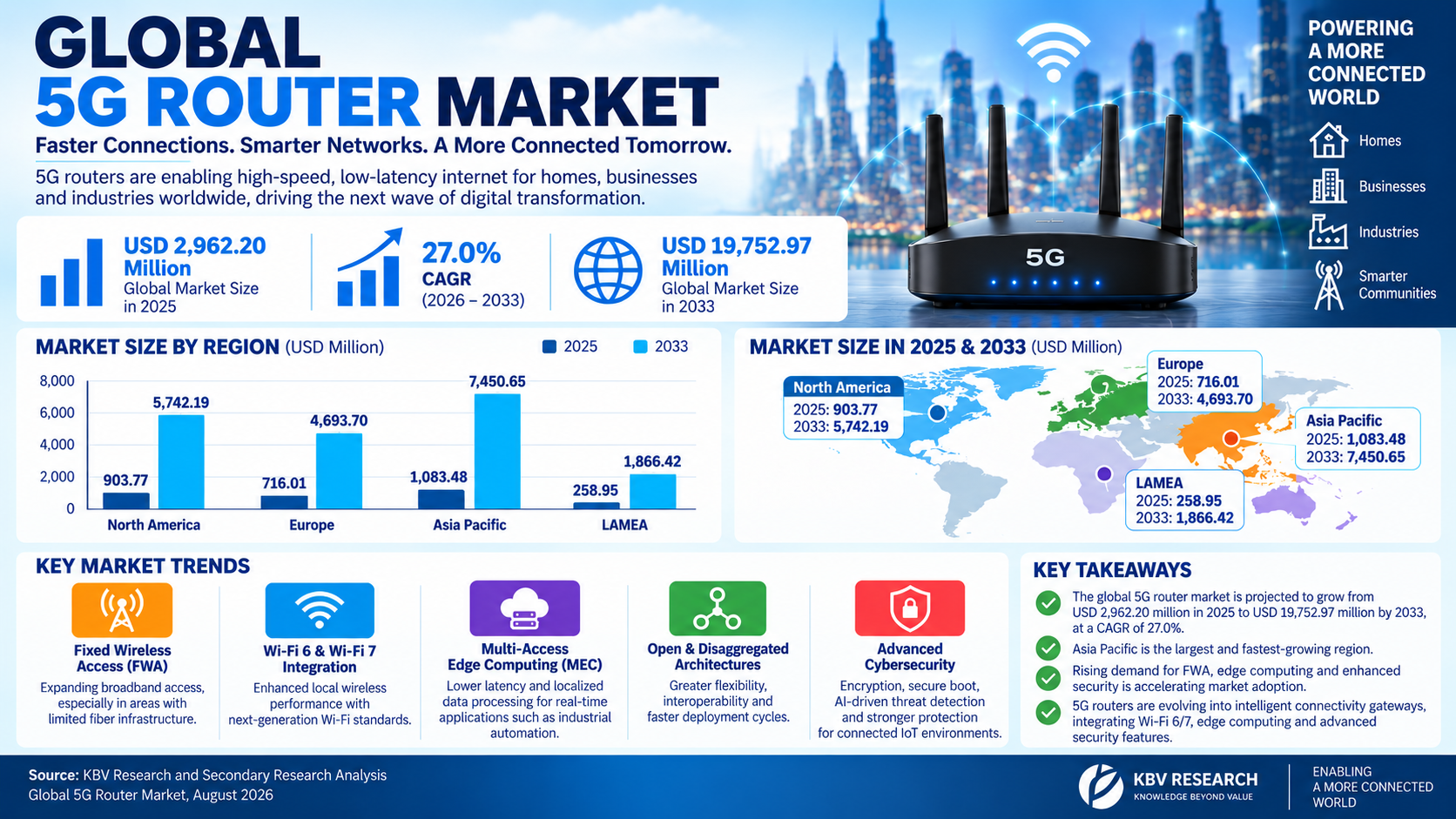
As 5G networks progressed beyond pilot deployments, 5G routers evolved to support the growing demand for Fixed Wireless Access (FWA). This became particularly important in regions where fiber infrastructure was limited, costly, or slow to deploy. By using 5G connectivity as an alternative broadband solution, routers became an increasingly important bridge between cellular networks and homes, businesses, and industrial facilities.
Key Turning Points in 5G Router Development
A major development was the introduction of enterprise-grade 5G routers designed to support business-critical and mission-critical applications requiring high levels of reliability and network performance.
Another important shift was the emergence of open and disaggregated router architectures, offering greater flexibility, customization, scalability, and interoperability. Together, these developments helped move 5G routers beyond niche applications and establish them as important components of modern connectivity infrastructure.
Today, 5G routers increasingly combine cellular connectivity with advanced local networking technologies such as Wi-Fi 6 and Wi-Fi 7, improving wireless performance within homes and enterprises while using 5G networks for internet backhaul.
Key Trends Shaping the 5G Router Market
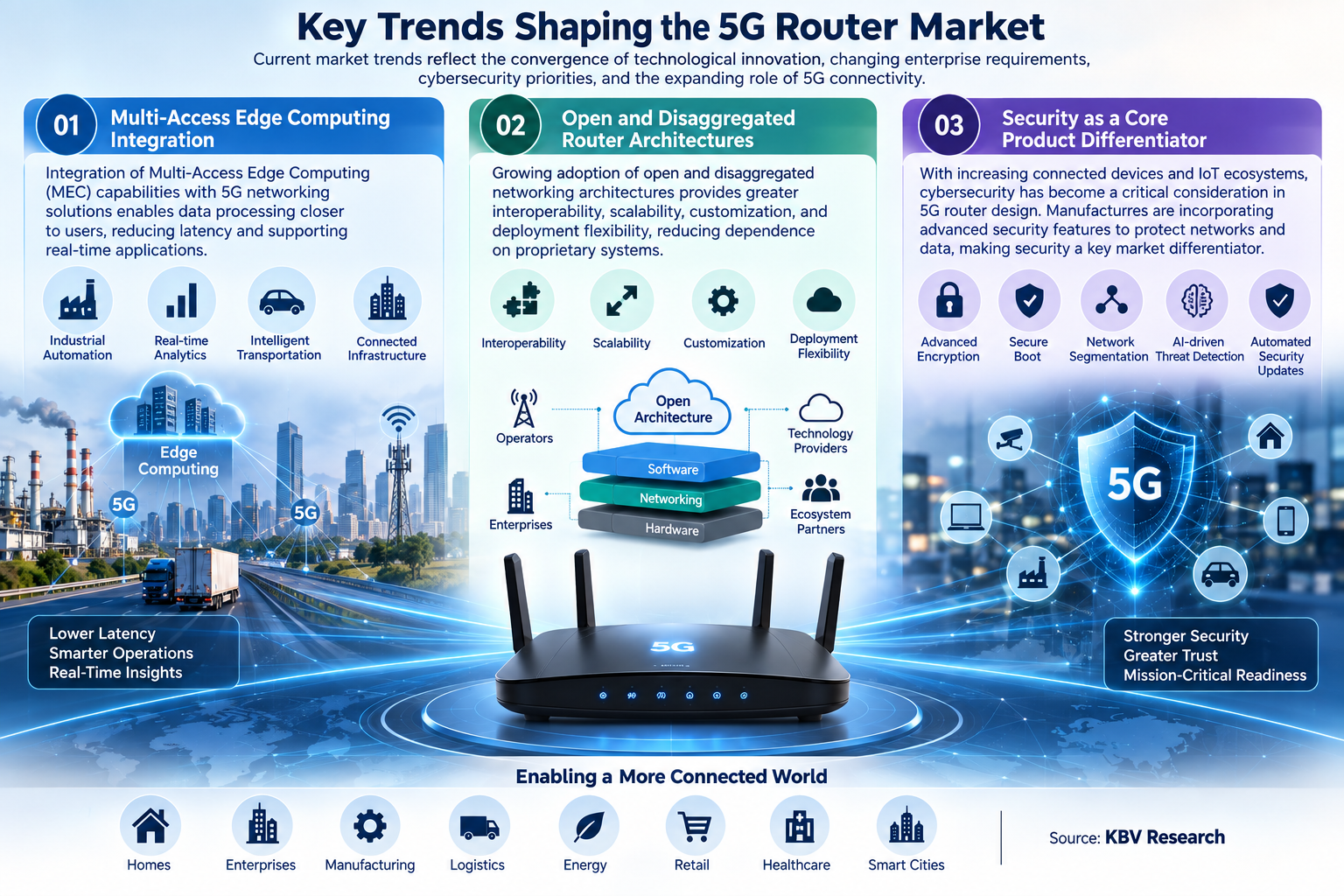
Current market trends reflect the convergence of technological innovation, changing enterprise requirements, cybersecurity priorities, and the expanding role of 5G connectivity.
Multi-Access Edge Computing Integration
One of the most significant trends is the integration of Multi-Access Edge Computing (MEC) capabilities with 5G networking solutions.
Edge capabilities enable data to be processed closer to users and connected devices, reducing latency and supporting applications such as industrial automation, real-time analytics, intelligent transportation, and connected infrastructure.
As a result, 5G routers are evolving beyond basic connectivity devices and increasingly becoming gateways supporting distributed and edge-oriented computing environments.
Open and Disaggregated Router Architectures
The market is witnessing growing interest in open and disaggregated networking architectures as operators and enterprises seek alternatives to tightly integrated proprietary systems.
These architectures can provide greater interoperability, scalability, customization, and deployment flexibility, while potentially reducing dependence on individual technology vendors.
This transition is particularly relevant for telecommunications operators and enterprises seeking flexible network infrastructure that can evolve alongside changing 5G requirements.
Security as a Core Product Differentiator
With the rapid growth of connected devices and IoT ecosystems, cybersecurity has become a critical consideration in 5G router design.
Manufacturers are strengthening their products through advanced encryption, secure boot mechanisms, network segmentation, automated security updates, AI-assisted threat detection, and enhanced device authentication.
Security is therefore evolving from an additional feature into an important competitive differentiator, particularly for enterprise, industrial, and mission-critical deployments.
Strategies Adopted by Key 5G Router Market Players
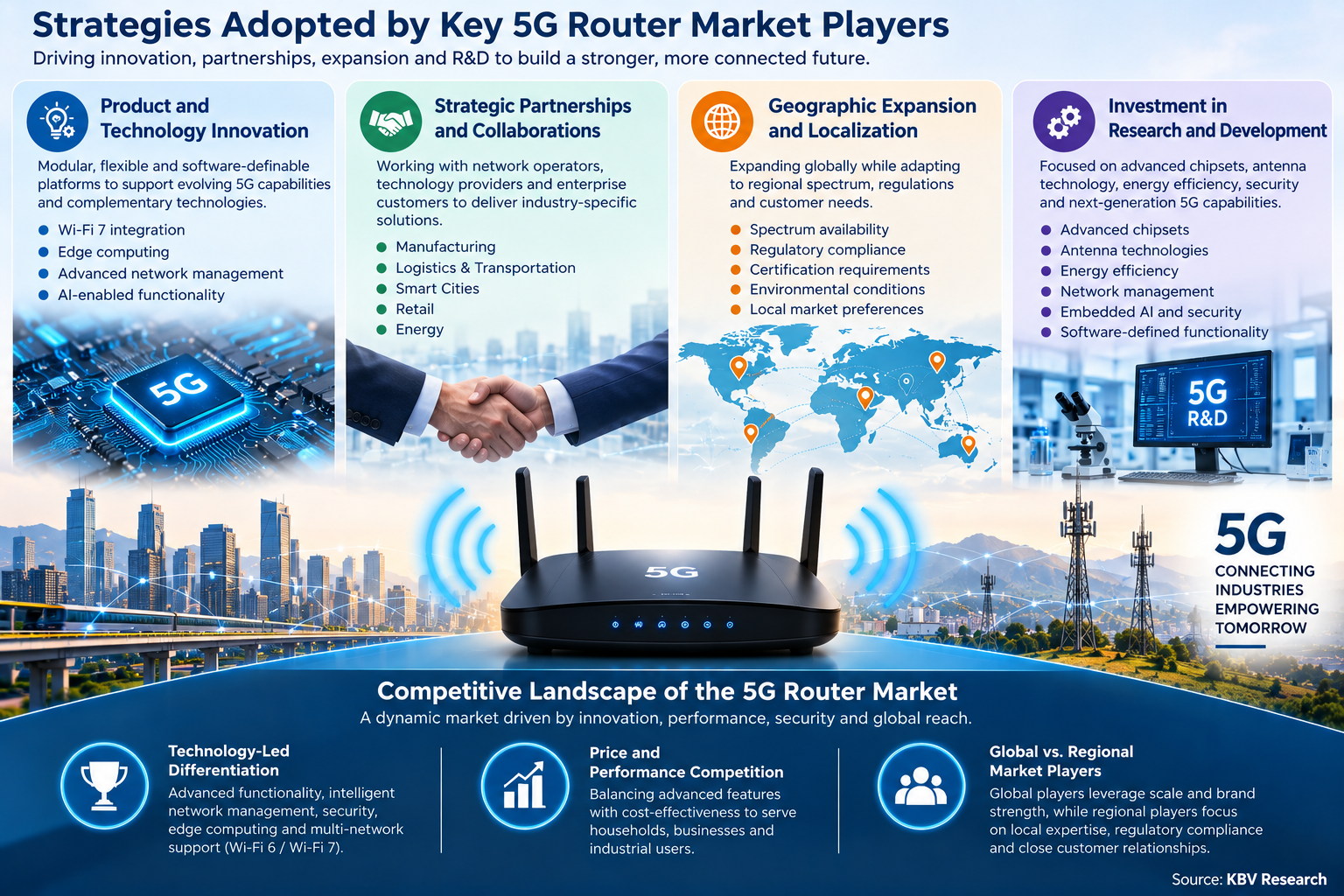
Companies operating in the 5G router market are pursuing multiple strategies to accelerate technological development, expand their customer base, and strengthen their competitive positioning.
Product and Technology Innovation
Innovation strategies increasingly emphasize modular, flexible, and software-definable platforms that can be updated to accommodate new 5G capabilities and complementary networking technologies.
Support for technologies such as Wi-Fi 7, edge computing, advanced network management, and AI-enabled functionality allows manufacturers to address evolving requirements across consumer, enterprise, and industrial environments.
Strategic Partnerships and Collaborations
Partnerships between network operators, router manufacturers, technology providers, and enterprise customers are becoming increasingly important.
These collaborations support the development of specialized 5G connectivity solutions for industries such as manufacturing, logistics, transportation, smart cities, retail, and energy. They can also simplify deployment by combining devices, connectivity, management software, and related services into integrated offerings.
Geographic Expansion and Localization
Market participants are expanding geographically while adapting their products to regional requirements.
Localization may involve adjustments for spectrum availability, telecommunications regulations, certification requirements, environmental conditions, and customer usage patterns. This approach can help companies strengthen adoption across both mature and emerging 5G markets.
Investment in Research and Development
Continued investment in R&D remains fundamental to competitive positioning.
Major areas of development include advanced chipsets, antenna technologies, energy efficiency, network management, embedded AI, security, and software-defined functionality. These investments are aimed at improving router performance while preparing products for the continuing evolution of 5G networks.
Competitive Landscape of the 5G Router Market
The 5G router market is highly dynamic, with competition shaped by technological capabilities, pricing, product reliability, security, geographic presence, and the ability to address specialized customer requirements.
Technology-Led Differentiation
Leading market participants increasingly compete through advanced functionality rather than connectivity speed alone.
Differentiating capabilities include high-performance connectivity, intelligent network management, advanced security, edge computing integration, multi-network support, and Wi-Fi 6/Wi-Fi 7 compatibility.
As 5G technology matures, these additional capabilities are becoming increasingly important in determining product positioning.
Price and Performance Competition
Competitive pricing remains important, particularly as 5G routers expand into a broader range of consumer and business applications.
Manufacturers must balance advanced functionality with cost-effectiveness, enabling them to address customers ranging from households and small businesses to large enterprises and industrial operators.
Global vs. Regional Market Players
Global companies can leverage large R&D budgets, extensive distribution networks, established brands, and broad technology portfolios to compete across multiple markets.
Regional players can differentiate themselves through local market knowledge, regulatory expertise, customized products, responsive support, and close customer relationships.
This combination of global scale and regional specialization contributes to an increasingly diverse and competitive marketplace.
5G Router Market Outlook
The role of the 5G router is continuing to expand as 5G, Fixed Wireless Access, Wi-Fi 7, IoT, edge computing, and enterprise digitalization increasingly converge.
Rather than functioning solely as devices that provide internet connectivity, next-generation 5G routers are evolving into intelligent connectivity gateways capable of supporting local wireless networks, cellular backhaul, connected devices, security functions, and edge applications.
As the global 5G ecosystem continues to mature, competition is expected to increasingly center on performance, security, software capabilities, interoperability, flexibility, and application-specific solutions. Companies capable of combining technological innovation with competitive pricing and strong ecosystem partnerships will be better positioned to capture emerging opportunities across consumer, enterprise, and industrial connectivity environments.
Scope
Report Scope
Segment Scope
Segments
- Application
- Commercial
- Industrial
- Other Application
- Residential
- Connectivity
- Non-Standalone
- Standalone
- End Use
- Enterprises
- Healthcare
- Other End Use
- Telecom
- Transportation
- Product Type
- Indoor 5G Routers
- Outdoor 5G Routers
- Portable 5G Routers
Geography Scope
Geographies
- Asia Pacific
- Europe
- LAMEA
- North America
Subscriber Dashboard Preview
5G Router Market
Preview the charts, CAGR cards, filters, and raw tables available after subscription. Chart and table values are locked until access is approved.
Scope
Report Scope
Segment Scope
Segments
- Application
- Commercial
- Industrial
- Other Application
- Residential
- Connectivity
- Non-Standalone
- Standalone
- End Use
- Enterprises
- Healthcare
- Other End Use
- Telecom
- Transportation
- Product Type
- Indoor 5G Routers
- Outdoor 5G Routers
- Portable 5G Routers
Geography Scope
Geographies
- Asia Pacific
- Europe
- LAMEA
- North America
Free Account
Submit Your Information
Submit the form to request sample access for this report.
- Access sample report pages
- Request dashboard access
- Download available charts and report assets











































