
 Action Camera Market
Total Market Chart
Global Action Camera Market
Action Camera Market: Evolution, Emerging Trends & Competitive Landscape
Evolution of Action Camera
The action camera market originated in the early 2000s as a niche segment within consumer electronics, primarily serving enthusiasts seeking compact devices capable of recording adventurous, outdoor, and high-motion activities.
Early product development focused on rugged and portable camera designs, basic video recording capabilities, and waterproof or protective housings suitable for extreme sports and challenging environments. As imaging technology advanced, improvements in camera sensors, battery technology, image processing, and device miniaturization enabled manufacturers to deliver higher video resolutions, wider fields of view, improved durability, and better overall image quality.
The integration of digital image stabilization and wireless connectivity represented an important stage in market development. These capabilities expanded action cameras beyond extreme sports by making them more convenient for travel, automotive applications, security, professional activities, and everyday content creation.
Key Turning Points in Action Camera Development
One of the major turning points was the transition from standalone recording devices toward integrated content-creation ecosystems combining cameras, mounting accessories, mobile applications, editing tools, and wireless sharing capabilities.
The proliferation of social media platforms and digital content creation further accelerated adoption. Consumers increasingly sought compact cameras capable of capturing immersive, high-quality, and easily shareable content while participating in sports, travel, outdoor recreation, and everyday activities.
Features such as 4K and higher-resolution recording, advanced stabilization, wireless connectivity, live streaming, and mobile application integration subsequently became increasingly important in product differentiation.
As a result, action cameras have evolved from specialized hobbyist equipment into sophisticated consumer electronics products positioned within the broader digital content creation and lifestyle ecosystem.
Key Trends Shaping the Action Camera Market
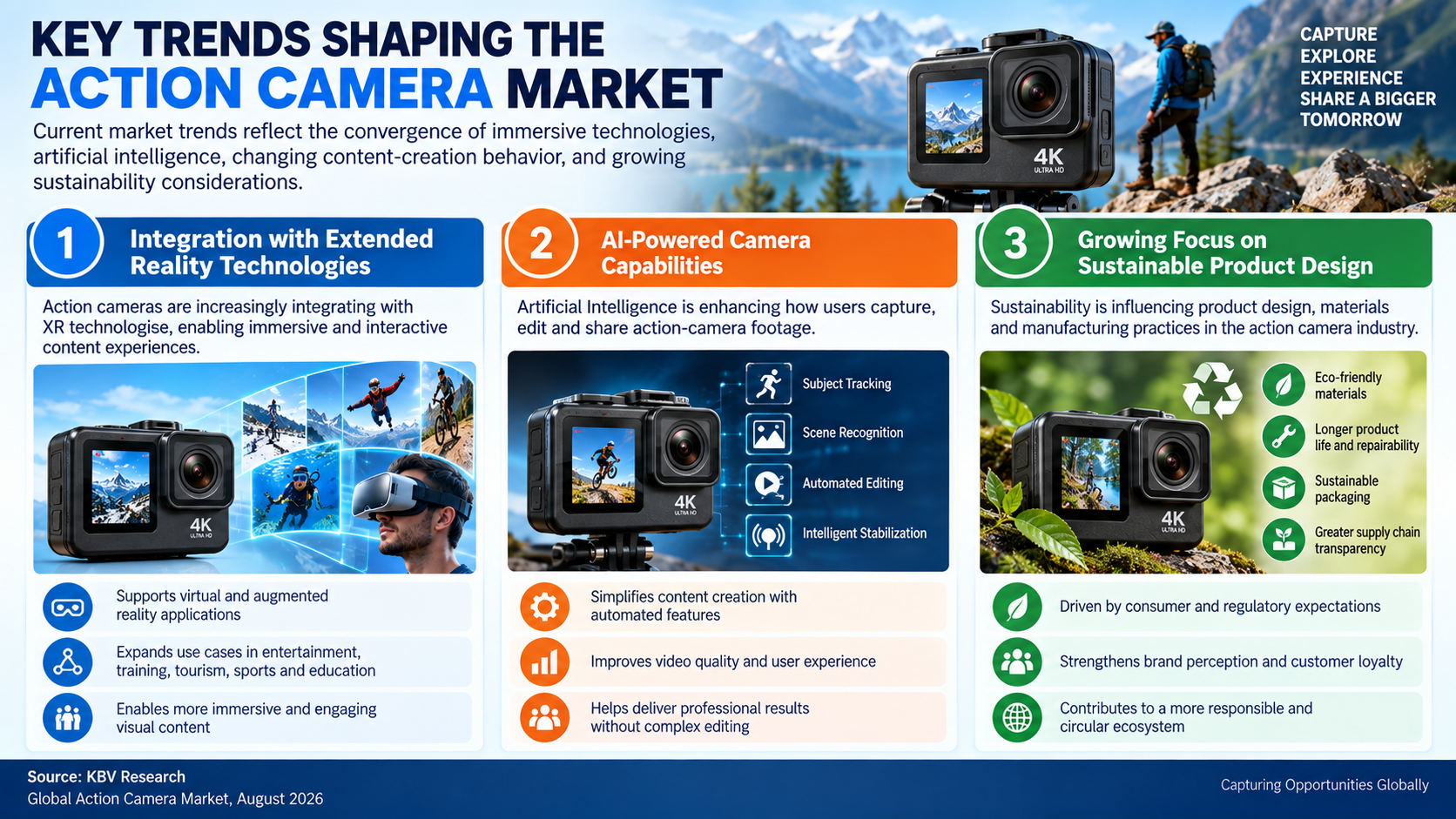
Current market trends reflect the convergence of immersive technologies, artificial intelligence, changing content-creation behavior, and growing sustainability considerations.
Integration with Extended Reality Technologies
One of the prominent trends influencing the market is the growing integration of action cameras with Extended Reality (XR) technologies, including virtual reality and augmented reality applications.
The increasing demand for immersive and experiential content is encouraging manufacturers to enhance camera capabilities and compatibility with XR-oriented workflows. Such integration can broaden potential applications across entertainment, training, tourism, sports, education, and remote experiences.
As immersive digital experiences become more prevalent, action cameras capable of supporting these applications can move beyond conventional video recording and become important tools for creating interactive and engaging visual content.
AI-Powered Camera Capabilities
The increasing incorporation of Artificial Intelligence (AI) is transforming how users capture, process, edit, and share action-camera footage.
AI-enabled capabilities such as automated editing, scene recognition, subject tracking, intelligent stabilization, and content optimization can reduce the effort required to transform raw footage into polished digital content.
These capabilities are particularly valuable for consumers and content creators seeking high-quality results without complex post-production workflows. Consequently, intelligent software functionality is becoming an increasingly important component of the overall action camera experience.
Growing Focus on Sustainable Product Design
Sustainability considerations are also beginning to influence product design, materials, manufacturing processes, packaging, and supply-chain strategies within the action camera industry.
Growing environmental awareness among consumers and evolving regulatory expectations are encouraging manufacturers to consider eco-friendly materials, product longevity, repairability, and greater supply-chain transparency.
Sustainability can therefore influence not only manufacturing decisions but also brand perception and customer loyalty, particularly among environmentally conscious consumers.
Strategies Adopted by Key Action Camera Market Players
Companies operating in the action camera market are pursuing multiple strategies centered on technological innovation, ecosystem development, partnerships, geographic expansion, and software-based services.
Product and Technology Innovation
Continuous product innovation remains fundamental to competitive positioning in the action camera industry.
Manufacturers are investing in advanced imaging sensors, image-processing algorithms, stabilization technologies, battery performance, connectivity, and software integration to improve video quality and overall usability.
Increasing attention to AI, immersive content capabilities, and intelligent software features is also enabling companies to differentiate products beyond traditional hardware specifications.
Strategic Partnerships and Collaborations
Partnerships with technology companies, outdoor brands, sports organizations, content creators, and ecosystem providers can help action camera manufacturers expand both technological capabilities and market reach.
Technology collaborations can accelerate developments involving AI, wireless connectivity, software, and XR technologies, while partnerships with sports and outdoor brands provide opportunities to engage directly with important customer communities.
These collaborations can strengthen brand visibility while demonstrating camera capabilities through authentic, application-specific environments.
Geographic Expansion and Localization
Market participants are also pursuing geographic expansion strategies to strengthen their presence across developed and emerging markets.
Localization involves adapting product offerings, pricing, marketing strategies, distribution channels, and customer engagement to regional consumer preferences and market requirements.
This approach allows companies to address differences in purchasing power, digital-content behavior, recreational activities, and distribution environments across individual markets.
Software, Cloud and Ecosystem Development
Action camera manufacturers are increasingly focusing on the broader ecosystem surrounding their hardware products.
Investment in proprietary mobile applications, editing software, cloud storage, content-management platforms, and subscription-based services can extend customer relationships beyond the initial device purchase.
An integrated ecosystem can also improve customer retention by creating a seamless workflow encompassing content capture, editing, storage, management, and sharing.
Competitive Landscape of the Action Camera Market
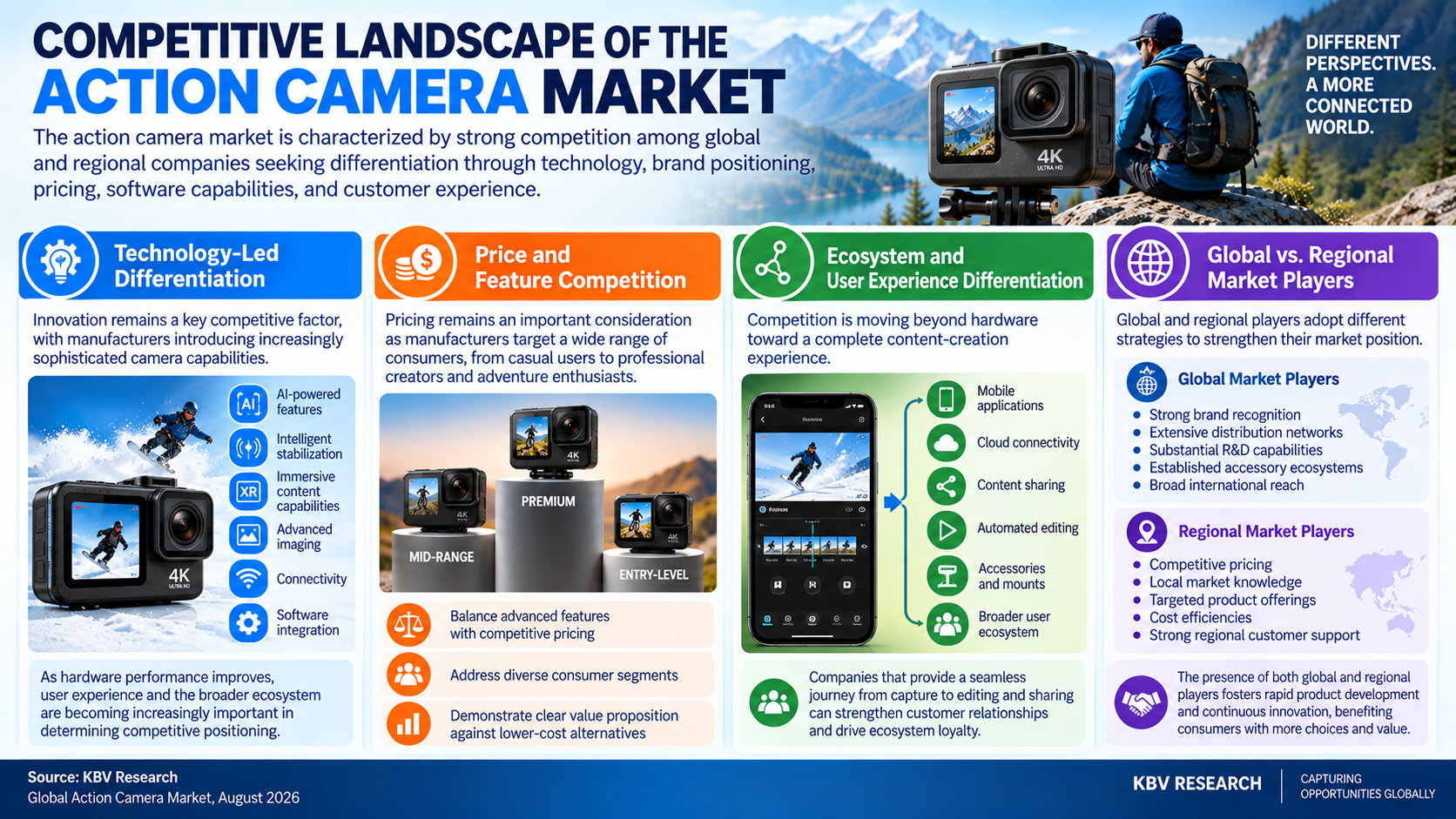
The action camera market is characterized by strong competition among global and regional companies seeking differentiation through technology, brand positioning, pricing, software capabilities, and customer experience.
Technology-Led Differentiation
Innovation remains one of the most important competitive factors as manufacturers seek to introduce increasingly sophisticated camera capabilities.
Competitive differentiation is expanding toward AI-powered functionality, intelligent stabilization, immersive content capabilities, advanced imaging, connectivity, and software integration.
As hardware performance improves across the industry, the overall user experience and supporting ecosystem are becoming increasingly important factors in determining competitive positioning.
Price and Feature Competition
Pricing remains an important consideration as manufacturers attempt to serve different categories of consumers, ranging from casual users and travelers to professional creators and adventure enthusiasts.
Companies must balance advanced imaging capabilities and intelligent features with accessible pricing, particularly as lower-cost competitors introduce products capable of addressing mainstream recording requirements.
This creates a competitive environment where manufacturers must clearly demonstrate the value of premium features while maintaining attractive price-to-performance propositions.
Ecosystem and User Experience Differentiation
Competition is increasingly moving beyond camera hardware toward the complete content-creation experience.
Mobile applications, automated editing, cloud connectivity, wireless transfer, content sharing, accessories, and mounting ecosystems can influence purchasing decisions alongside conventional specifications such as resolution and image stabilization.
Companies capable of creating a seamless journey from capturing footage to editing and sharing content can establish stronger customer relationships and encourage ecosystem loyalty.
Global vs. Regional Market Players
Global companies can leverage strong brand recognition, extensive distribution networks, substantial R&D capabilities, established accessory ecosystems, and broad international reach.
Regional and emerging players can compete through competitive pricing, local market knowledge, targeted product offerings, and cost efficiencies, particularly within price-sensitive markets.
This interaction between global brands and regional competitors contributes to rapid product-development cycles and continued pressure on manufacturers to enhance both functionality and value.
Action Camera Market Outlook
The action camera market is evolving as AI, immersive technologies, social media, wireless connectivity, cloud services, and digital content creation increasingly converge.
Action cameras are moving beyond their traditional association with extreme sports and becoming versatile recording devices used across sports and adventure, travel and tourism, automotive applications, emergency services, security, and other content-capture environments.
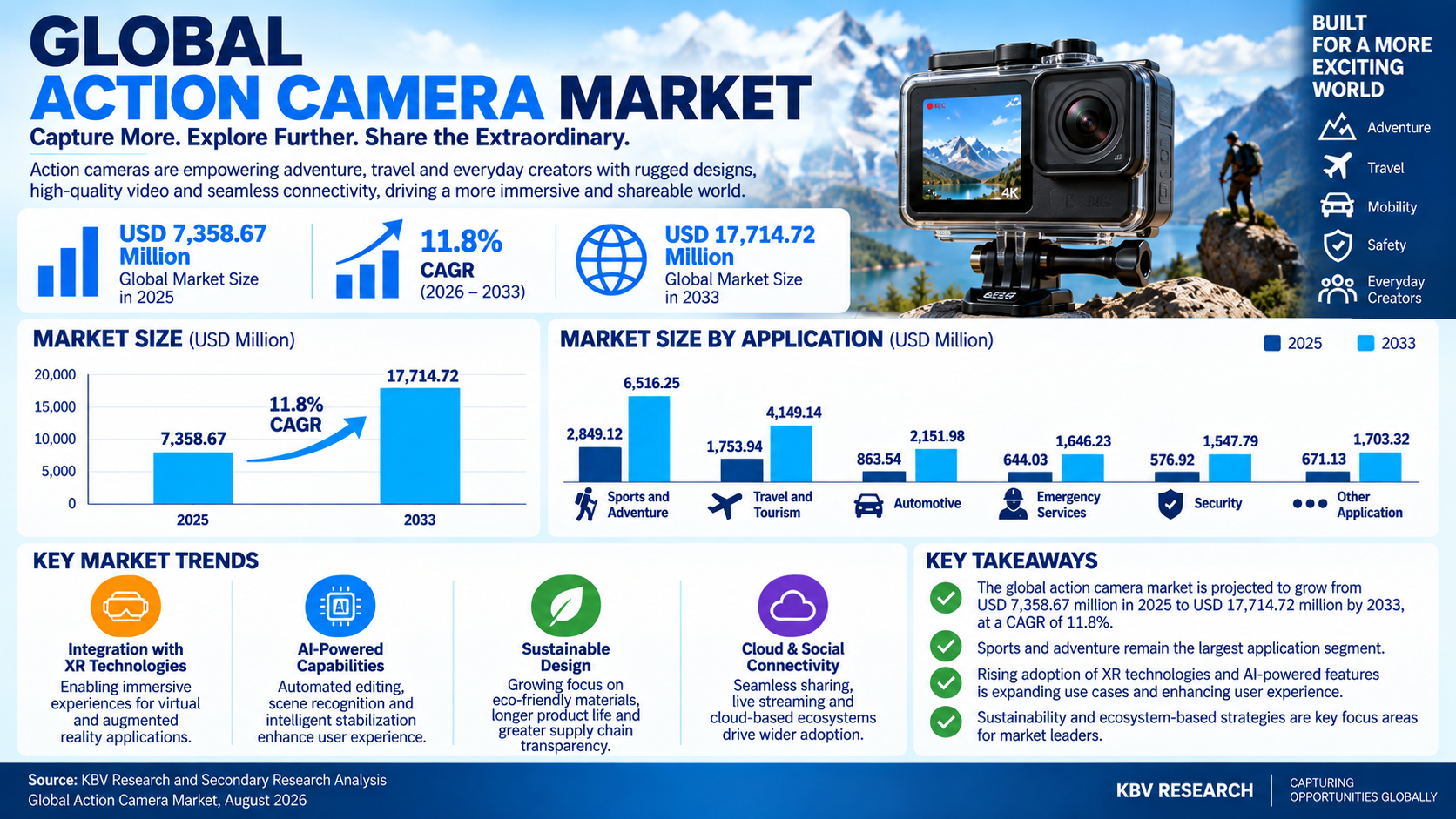
The global action camera market is projected to increase from USD 7,358.67 million in 2025 to USD 17,714.72 million by 2033, representing a CAGR of 11.8% during 2026–2033.
Among applications, Sports and Adventure represents the largest segment, increasing from USD 2,849.12 million in 2025 to USD 6,516.25 million by 2033. Travel and Tourism is projected to increase from USD 1,753.94 million to USD 4,149.14 million, while Automotive is expected to grow from USD 863.54 million to USD 2,151.98 million over the same period.
As competition intensifies, differentiation is expected to increasingly depend on image quality, AI capabilities, stabilization, immersive-content support, software ecosystems, connectivity, sustainability, and price-to-performance. Companies capable of combining advanced hardware with intuitive software and integrated content-creation experiences will be better positioned to address the evolving requirements of consumers and professional users.
View the Complete Action Camera Market Analysis
Scope
Report Scope
Segment Scope
Segments
- Application
- Automotive
- Emergency Services
- Other Application
- Security
- Sports and Adventure
- Travel and Tourism
- Distribution Channel
- E-commerce
- Offline
- Product
- 360-degree Camera
- Box Style Camera
- Bullet Style Camera
- Cube Style Camera
- Other Product
- Resolution
- 4K and Above
- HD & Full HD
- Ultra HD
Geography Scope
Geographies
- Asia Pacific
- Europe
- LAMEA
- North America
Subscriber Dashboard Preview
Action Camera Market
Preview the charts, CAGR cards, filters, and raw tables available after subscription. Chart and table values are locked until access is approved.
Scope
Report Scope
Segment Scope
Segments
- Application
- Automotive
- Emergency Services
- Other Application
- Security
- Sports and Adventure
- Travel and Tourism
- Distribution Channel
- E-commerce
- Offline
- Product
- 360-degree Camera
- Box Style Camera
- Bullet Style Camera
- Cube Style Camera
- Other Product
- Resolution
- 4K and Above
- HD & Full HD
- Ultra HD
Geography Scope
Geographies
- Asia Pacific
- Europe
- LAMEA
- North America
Free Account
Submit Your Information
Submit the form to request sample access for this report.
- Access sample report pages
- Request dashboard access
- Download available charts and report assets











































